
At the heart of the famous passage at the end of Revelation, where the loud voice from the throne declares, ‘I am making all things new’, is an angel.
The angel takes over the role of tour guide and narrator from the one on the throne, and shows John around this extraordinary final set of visions. He will carry John, and with him us, away in the Spirit to a mountain great and high. There we will witness the majestic experience of seeing heaven touching earth as a new heaven and new earth are formed as the ‘Holy City, Jerusalem,’ ‘comes down out of heaven from God.’ But it’s not just a tour of a heavenly city in mind. There is a reason for this celebration and city: It’s been made ready for the Church of God. Or as the angel puts it:
“Come, I will show you the bride, the wife of the Lamb.”
He is introduced with one small sentence:
‘One of the seven angels who had the seven bowls full of the seven last plagues came…’
He has already had a starring role in Revelation as one of the judgment bringers. And there is no apology given for that. It turns out in Revelation judgement is what we have been longing for to get to this place where all things can be new.
The Lion and the Dragon
I’m reminded of CS Lewis again. The wonderful stories of Narnia. In particular the Voyage of the Dawn Treader where a particularly brattish pre-teenager gets whisked up on an adventure and can’t see the joy and wonder for the discomfort and unfamiliarity. Eustace Scrubb ends up on a self-centred quest to sort out his own life that leaves him stuck in a dragon’s cave, cursed by greed to transform into a dragon himself. Then in a rare beach setting he meets Aslan.
You may remember Professor Michael Ward’s thesis about Narnia we explored in Chapter Thirteen. He believed that each of the 7 chronicles of Narnia should be interpreted through the lens of one of the medieval planets and the mythology surrounding the gods associated with them. Those planets included the sun and moon. Voyage of the Dawntreader is:
‘a story about a journey towards the rising sun. Aslan flies out of the sunbeam towards Lucy as an albatross; he appears in the room when she utters the spell to make invisible things visible; he is seen shining as if in bright sunlight, though the sun has in fact gone in, on Goldwater Island. Gold, of course, is the sun’s metal. The killing of dragons on Dragon Island is drawn from Homer’s Hymn where the sun-god Apollo is Sauroctonus, the lizard slayer.’
The killing of dragons is of course also in John’s mind as he pens the book revelation. The very same dragon in fact that CS Lewis had in mind. John is writing to a church he has pastored. Ephesus. Where Artemis of the Ephesians, older twin of Apollo, reigned hearts and minds for the ‘praise of her glory’. Lewis is remembering the same myth. A myth loaded, perhaps, with more spiritual power than we can realise given how hard it was for Paul and John to minister there (see Chapter Two).
The dragon needs sorting out. Eustace has become dragon-like. He is still Eustace, but by wearing a dragon’s trinket on his wrist he has succumbed to its ways. He is marked by the dragon. As he turns into the form of a dragon, still a boy underneath, the trinket remains the same size. The arm gets fatter. The bracelet cuts in. The mark is excruciating. He can’t tear it off.
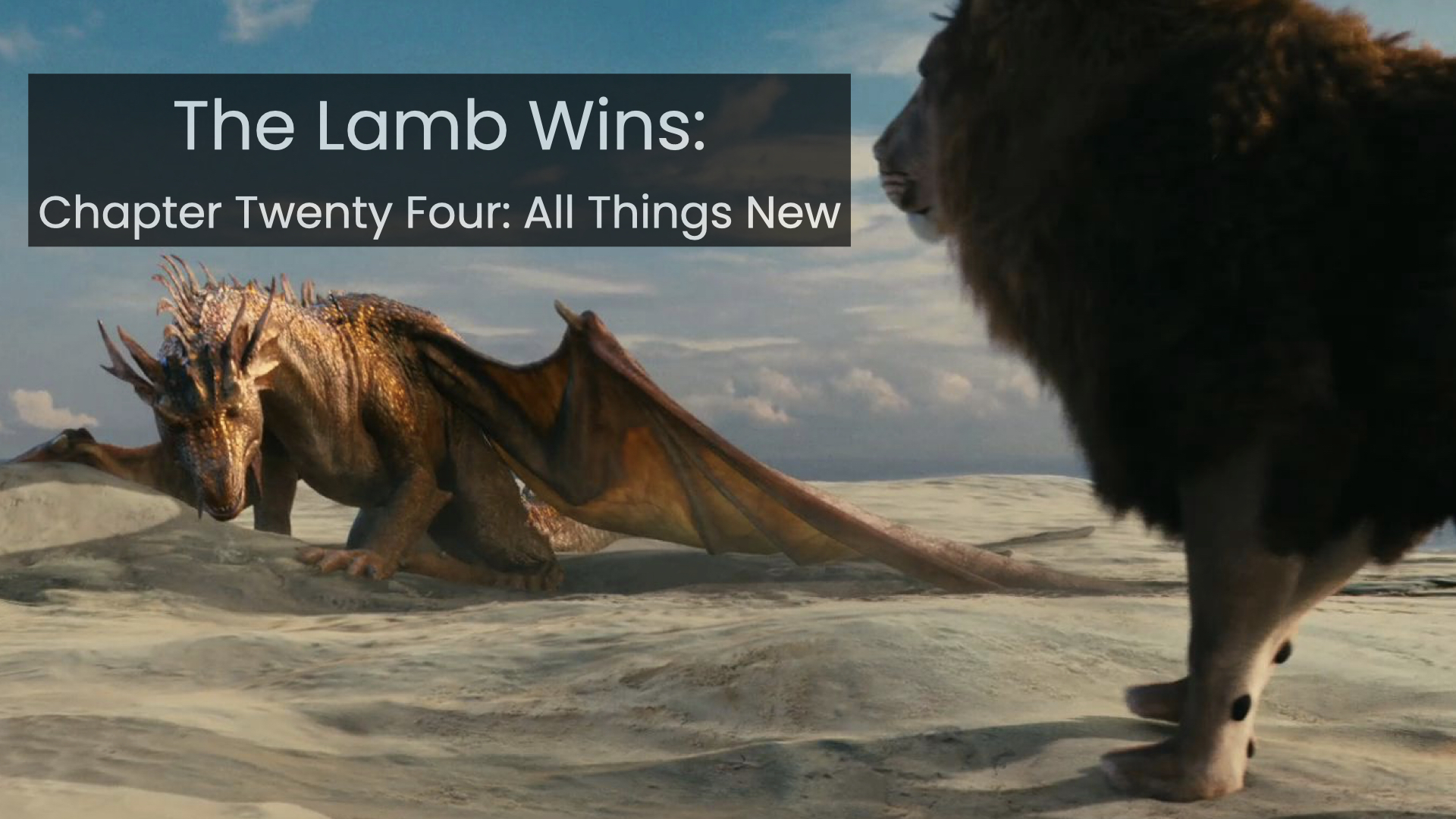
Nor can he leave behind his dragon shell. He’s trapped suddenly aware for the first time that the good he wants to do, he can’t do, and the evil he doesn’t want to do any longer he can’t stop doing. He is a fire breather. He is spiritually repulsive. He is dead in this dragon shell of a body.
And then he meets a lion. Who can save him from this body of death? A lion.
Later we find out that this lion is in fact a lamb. Eustace gets to meet him as a lamb once he has been restored:
‘But between them and the foot of the sky was something so white that even their eagle eyes they could hardly look at it. They came on and saw it was a Lamb… but as he spoke, his snowy white flushed into tawny gold and his size changed and he was Aslan himself, towering above them and scattering light from his mane.’
But before he gets to meet him as the Lamb, he first meets him as the Lion. As the Judge. As the slayer of dragons.
Disney portrayed it here, without the violence in Lewis’ book:
But check out the original:
Eustace is telling the story to his cousin Edmund:
“…I looked up and saw the very last thing I expected: a huge lion coming slowly toward me. And one queer thing was that there was no moon last night, but there was moonlight where the lion was. So it came nearer and nearer. I was terribly afraid of it. You may think that, being a dragon, I could have knocked any lion out easily enough. But it wasn’t that kind of fear. I wasn’t afraid of it eating me, I was just afraid of it—if you can understand. Well, it came close up to me and looked straight into my eyes. And I shut my eyes tight. But that wasn’t any good because it told me to follow it.”
“You mean it spoke?”
“I don’t know. Now that you mention it, I don’t think it did. But it told me all the same. And I knew I’d have to do what it told me, so I got up and followed it. And it led me a long way into the mountains… there was a garden—trees and fruit and everything. In the middle of it there was a well… The water was as clear as anything and I thought if I could get in there and bathe it would ease the pain in my leg. But the lion told me I must undress first…
So I started scratching myself and my scales began coming off all over the place… But just as I was going to put my feet into the water I looked down and saw that they were all hard and rough and wrinkled and scaly just as they had been before… Then the lion said—but I don’t know if it spoke—‘You will have to let me undress you.’ I was afraid of his claws, I can tell you, but I was pretty nearly desperate now. So I just lay flat down on my back to let him do it. The very first tear he made was so deep that I thought it had gone right into my heart. And when he began pulling the skin off, it hurt worse than anything I’ve ever felt. The only thing that made me able to bear it was just the pleasure of feeling the stuff peel off. You know—if you’ve ever picked the scab off a sore place. It hurts like billy-oh but it is such fun to see it coming away.”
“I know exactly what you mean,” said Edmund.
“Well, he peeled the beastly stuff right off—just as I thought I’d done it myself the other three times, only they hadn’t hurt—and there it was lying on the grass: only ever so much thicker, and darker, and more knobbly-looking than the others had been. And there was I as smooth and soft as a peeled switch and smaller than I had been. Then he caught hold of me—I didn’t like that much for I was very tender underneath now that I’d no skin on—and threw me into the water. It smarted like anything but only for a moment. After that it became perfectly delicious and as soon as I started swimming and splashing I found that all the pain had gone from my arm. And then I saw why. I’d turned into a boy again.” 1
Making All Things New
Aslan does what Eustace can’t do. As Eustace surrenders to his claws he performs deep surgery on the boy dragon. He tears off Eustace’s oppressive, controlling nature, and baptises him to be the person he was always meant to be. All things new.
This angel tour guide, this previous bringer of judgement, is an angelic reminder that before we get to Revelation 21 – where all things are made new – we get Revelation 20. There the dragon (Satan) is first bound for a thousand years, then finally thrown into a lake of sulfur, and then the inhabitants of the world are judged for whether they resemble the Dragon or the Lamb. The Beast or the Kingdom of God. The False Prophet or the Martyrs around the throne. The Prostitute or the Beautiful Bride.
It is the scene of the Great White Throne
Judgement Needed
Then I saw a great white throne and him who was seated on it. The earth and the heavens fled from his presence, and there was no place for them. And I saw the dead, great and small, standing before the throne, and books were opened. Another book was opened, which is the book of life. The dead were judged according to what they had done as recorded in the books. The sea gave up the dead that were in it, and death and Hades gave up the dead that were in them, and each person was judged according to what they had done. Then death and Hades were thrown into the lake of fire. The lake of fire is the second death. Anyone whose name was not found written in the book of life was thrown into the lake of fire.
It is final. It is into a lake of fire where the dragon, beast and false prophet ‘will be tormented forever and ever.’ [Rev 20:10]. It is absolutely not a place you want to go.
Put CS Lewis and Revelation together and you get the punchline: It is far better to let the Lion get his claws into you now, and rip that dragon’s skin of you tear by excruciating tear, than to wear a dragon’s clothing into eternity and go to dwell with the father of lies. You need a saviour. A Lamb who is also a Lion.
——————————-
A city, a garden and a marriage.
So what is on the other side of the judgement that makes such a redemption worth it? What is the angel so delighted to show us? Well it turns out there are three things: A city, a garden and a marriage.
- There is security in the City of God, the New Jerusalem
- There is restored access to the Garden of Eden’s Tree of Life
- There is intimate Relationship of the Bride and Bridegroom
The first eight verses of Revelation 21 are variations on newness…. It is a beautiful picture of:
‘A renewed universe, related to the present world by continuity and discontinuity. The new earth will not be a replacement universe but a regenerated universe, purged of all present imperfections… and now the dwelling of God will be with humankind.’ John Stott, Through the Bible in One Year, p.425
As we’ll see tomorrow the city of God will be the Holy City: a massive and impregnable fortress representing the completed church of both New and Old Testaments (Rev 21). The Garden is has a great life giving river, the tree of life and access to the throne (Rev 22). The Bride is us, not just on our best day, but on our eternal best day, renewed, restored, reconciled, redeemed, reenergised, remade into the people God always created us to be. It’s what you have been longing to be a part of your whole life.
But as it is a Narnia themed day I’ll close this Christmas Eve with some more CS Lewis. This time from the Last Battle. Where Lewis describes what ‘making all things new’ would look like to Narnia. It has the beautiful title of ‘farther up and farther in.’ My God give you grace to make that journey also:
Farther up and Farther In
“That grassy country was wide and there was no crowding. They kept on stopping to look around and to look behind them, partly because it was so beautiful but partly because there was something about it that they could not understand
“It reminds me of somewhere but I can’t give its name. Could it be somewhere we have stayed for a holiday when we were very small?” “It would have been a jolly good holiday…”
…”and yet they are not like”, said Lucy. “They’re different . They have more colours on them and they look further away than I remembered an they’re more…more…oh… I don’t know”
“More like the real thing” said Lord Digory softly
“When Aslan said you could never go back to Narnia he meant the Narnia you were thinking of… But that was not the real Narnia. It was only a shadow or a copy of the real Narnia that will always be here…
You need not mourn over Narnia, Lucy. All of the old Narnia that mattered, all the dear creatures, have been drawn into the Real Narnia through the Door. And of course it is different; as different as the real thing is from a shadow…
The new Narnia was a deeper country where every rock and flower and blade of grass looked as if it meant more. I can’t describe it better than that: if ever you get there you will know what I mean.
It was the Unicorn who summed what everyone was feeling.
“I have come home at last! This is my real country! I belong here. This was the life I was looking for all my life, though I never knew it until now. The reason I loved the old Narnia was that it sometimes looked a little this. Bree-hee-hee. Come farther up and farther in.”
Read More in this Series
The Lamb Wins Whole Series Catch Up : Introduction: Chp 1: Hope is Here | Chp 2: First, Love: Ephesus | Chp 3: Fear Not: Smyrna | Chp 4: I Know: Pergamum | Chp 5: Tolerate This: Thyatira | Chp 6: Wake Up: Sardis | Chp 7: Hold On: Philadelphia | Chp 8: Knock, Knock: Laodecia | Chp 9: What Must Soon Take Place | Chp 10: Holy Forever | Chp 11: Most Blessed | Chp 12: One That Was Slain | Chp 13: Come Home | Chp 14: Sun Forbear to Shine | Chp 15: 144000 | Chp 16 Sound of Silence | Chp 17: Spiralling Down | Chp 18 Two Witnesses | Chp 19 The Rapture | Chp 20 The Beast | Chp 21 False Prophet | Chp 22 Hallelujah | Chp 23 Millennium
Subscribe Below
If you have enjoyed this post why not check out somauk.org/stories and maybe even pay it forward by sharing the post and maybe take a moment to bless a brilliant charity? SOMA UK relies of the generosity of churches and supporters to fulfil our marvellous ministry – encountering God globally. Every donation goes a long way.
To support our ministry it’s www.somauk.org/donate
- C.S. Lewis, The Voyage of the Dawn Treader(New York: Harper Collins, 1994), pp. 113–16. ↩︎
 Your name is like honey