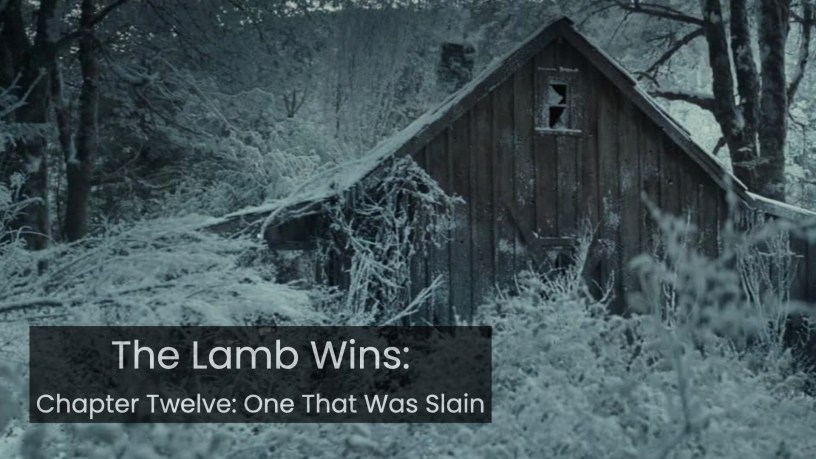
[GUIDANCE: contains material all readers may find upsetting].
The image of heaven in Revelation 4-5 continues with our Lord and God receiving glory, honour and power, the appearance of a mighty angel and a scroll. No one can be found worthy of opening this scroll and this causes John, the narrator, to weep and weep. The scroll contains God’s will for the world. A will that we will find out later contains both redemption and judgement.
Suddenly an elder tells him the Lion of Judah, the Root of David has triumphed. The promised powerful Messiah is here. He can open it.
Except the Lion doesn’t show up. A Lamb shows up. A Lamb that looks as if it had been slain. He stands in the centre of the throne and seems to take the place formerly given to the Lord Almighty. The Lamb becomes the object of prayer and worship. He is sung to. Myriads of angels join the living creatures (creation) and the elders (the saints/leaders of God’s people) in new songs of praise of the Lamb. They prostrate themselves at His feet in worship.
The Lion is the Lamb. A slain Lamb is the Lion. The scroll can only be opened by the slain Lamb.
That’s an image I am holding onto this December.
It helped me get through leading Communion yesterday.
Like hundreds of clergy and thousands of lay people today I had taken a break from my day job and church Christmas duties to watch the documentary ‘See No Evil.’ This is a Channel 4 retelling of the John Smyth debacle about a British lay reader licensed from 1974 at Christ Church Winchester, who was a notable Barrister and Queens’ Counsel, and Chair of the public school Iwerne Camps. Camps that were loosely under the auspices of Scripture Union and now come under Titus Trust.
It’s hard to exaggerate the impact of these camps. Michael Green, the renowned evangelist, said he ‘had no hesitation whatsoever in regarding Iwerne as the main ingredient in my own spiritual growth.’1 John Stott was converted there. Alister McGrath saw these camps as a key reason for the renaissance of British Evangelicalism in the post-war era.2 Alumni included Bishops like David Shepherd, Timothy Dudley Smith and Maurice Wood, and many of the leaders of larger ‘student’ churches.3 A young Justin Welby was also a group leader there , although his memory of his involvement has varied over the years.4
The Channel Four documentary See No Evil was harrowing in the extreme. Almost all of it was information already known through Andrew Graystone and Cathy Newman’s previous exposées. But it includes deeply personal video with three of the victims, two of whom were best friends. There were also extensive segments of family members coming to terms with what their husband or father had done, and clips of Smyth having national prominence: alongside, Margaret Thatcher, defending Mary Whitehouse’s morality campaigns on TV as well as very human footage of holidays and camp life.
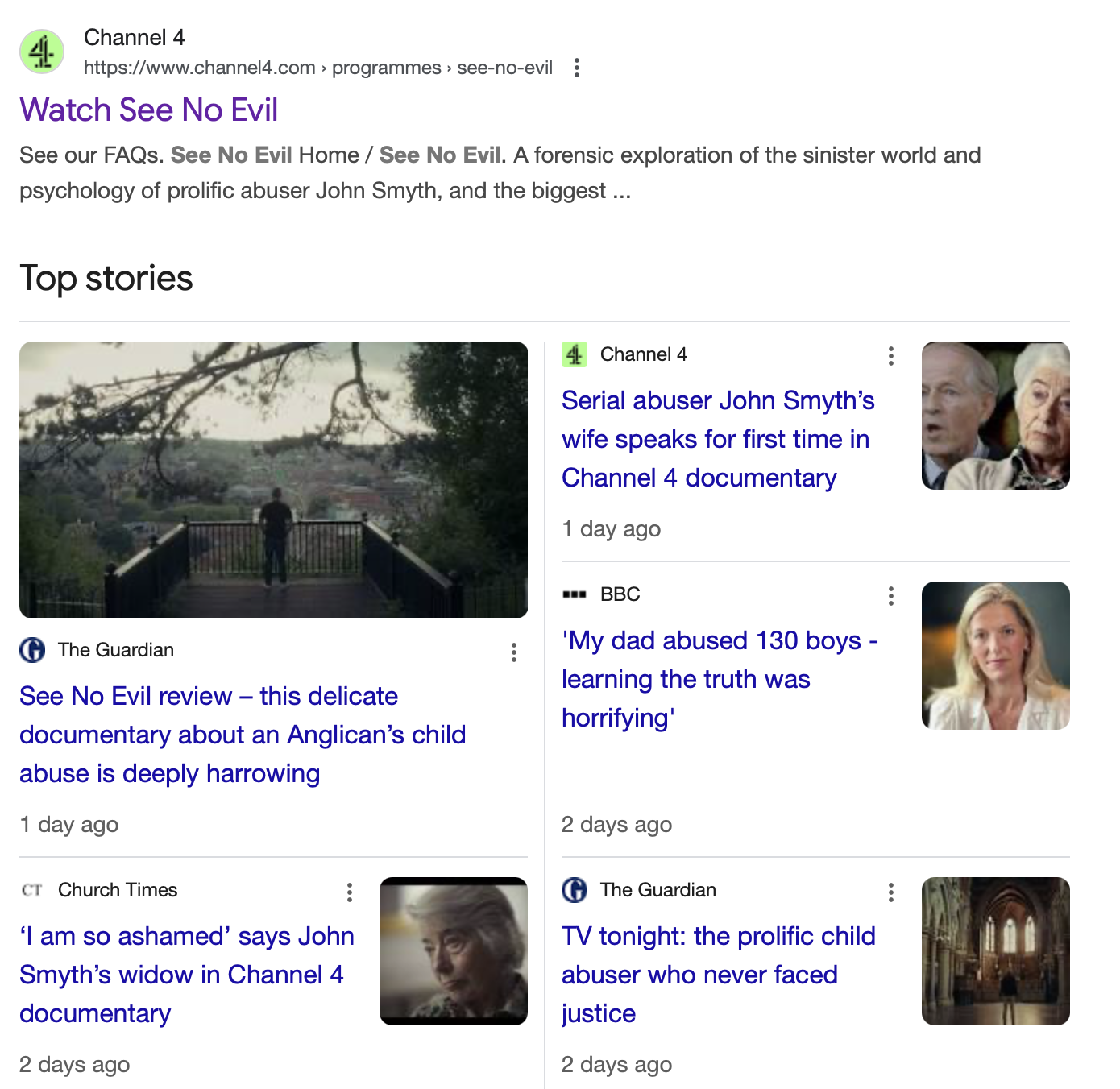
The hinge point between the two episodes is the decision by what I wanted to call a ‘cabal’ of evangelical clergymen and lay people to send Smyth and family to Africa after his rampant abuse of teenage boys in a shed in Winchester has come to light.
It is a shocking cliff hanger, even when you know the outcome. One that leads to the death, (the documentary hints at possible murder), of an African boy at the new camps Smyth is enabled to set up in Zimbabwe. All this while the Smyths were living a ‘missionary’ life of colonial luxury with a pool in their family home. Such is the generosity of provision he received from backers in the UK that he was even able to purchase a neighbouring house as a bunk room to accommodate his fresh supply of victims. One of those backers was reported by Patrick Foster in the Daily Telegraph in 2017 to have channeled hundreds of thousands of pounds to his ministry despite knowing his crimes.5
A young aspiring oil executive also sent a donation.
In the documentary Smyth’s young children know little of what is going on. Although the eldest, who became a famous preacher, ‘PJ Smyth’, discovers he has repressed memories of also being beaten as a young boy in that Winchester shed by his own father. The younger girls recall hiding a lot and keeping away from a father whose temper could flare in a moment. The public jury is still out on whether his wife might be best seen as his first victim, or complicit in his abuse. Perhaps both. By Anne Smyth’s own account he discussed the abuse with her in advance. But she was from a culture that silenced women. She was just one of the many, many, people who chose to ‘Speak No Evil’, and whose silence meant a rampaging sadist was let loose on children for 30 years longer than it might have been.
Several contributors spoke of him as ‘diabolical’. Both his wife and Andy Morse spoke of there being more than one version of Smyth. Morse’s suicide attempt was the trigger for the group sending Smyth into exile. They promised him Smyth would be dealt with and then encouraged him (told him) to keep quiet about it for the sake of the greater good of Iwerne. There was a version of Smyth that was charming, respectable, dined with the gentry and politicians, and made the boys feel like he was a father to them. There was a version that was anger. Violent. A psychological mix of narcissism, OCD, sadism and that Jekyll and Hyde ability to seem like a perfect father substitute – until you were under his grip and it was too late.
Midway through episode 2 I was due to preside at a service. I was thinking of my readings in Revelation. The five out of seven churches who get seriously rebuked in Revelation 1-3, and the ‘Lamb who was slain’ seated upon the throne in Revelation 5. The one who was worthy of opening the scroll that contained the story of God’s judgement and revelation to come.
I barely made it through the service. It just seemed inconceivable that not only would someone perpetuate such crimes, but that a group of British clergy and laymen would think it permissible to let him carry on doing the same things in Africa for miserable decade after miserable decade.
It reminded me of an abuse story I had heard on a mission. Someone who had been whipped by religious leaders of another faith. Tormented by what had been done to her. I had heard her forgive the brother and father who had impacted her life so terribly, and receive a measure of release by doing so. I had then heard her tell God she never wanted to see these imans again, but handed them over to God to deal with as he would. That seemed to produce significant psychological and spiritual release for her.
The reason she could make those steps was that she had come to believe over many months that there was a God who had died for her. Who knew what it was like to be whipped and beaten, ostracised and abused. A God who had been prepared to be a sacrificial lamb for her and all who believed. A God who would take the full deserved punishment upon himself, a God who did not leave her, would not forsake her, but had been with her somehow in all the pain. A God who understood and who had decisively intervened in history.
But I was still angry as a witness to this pain and suffering – as told to me and as told to the TV programme makers. The image of a shed on the screen had reminded me of The Shack film, a theological upgrade on the book of the same name by WM Paul Young. That film has a shack that is a place of horror. This one had a shed. I was angry at God for being there or not being there. For presence or absence without intervention. Elie Wiesel had famously said that ‘God is hanging here on these gallows’ when witnessing the senseless hanging of a child in Auschwitz. Christ died once for all at Calvary. Is he still hanging there / suffering there in all the thousands of stories of hurt I have seen/heard over the past few years. Was he in the shed? Was he in the shack?
In the Shack film, God meets a hurting father when he returns to the place of his daughter’s gruesome murder. He meets him as a Father, as Jesus and as the Spirit – but each person of the Trinity is portrayed differently and in a way that Mack can access. Initially the Father is portrayed as an Afro-American woman called ‘Papa’ (his wife’s affectionate term for God), until it comes the time to retrieve his lost daughter’s body, where the Father is then revealed as a native-American chieftain (after some of Mack’s own deep hurts with his human father have begun to be healed).
It’s very American imagery, and no doubt annoyed a few people with its take on who Father God might reveal himself to be. But emotionally it connects ever so deeply, speaking truth to hurting souls with a depth that is needed to reach into large and gaping wounds. A God who gets it. A God who knows pain. Who has lived it – in each person of the Trinity.
I’m still angry, annoyed, frustrated as I write this. The group I wanted to call a ‘cabal’ will have lived and died knowing they perpetuated a monstrosity. What they saw dimly got dragged into blazing light and they have been found desperately wanting. It shows why safeguarding training remains vital no matter what you think you already know. It is critical, potentially life-saving, to be held to account and to be forced to reflect on what you are doing, to whom, for whom, and why.
But there was only One in heaven found worthy to open the scroll. Only one righteous. And He had been slain. Thank goodness this Christmas that we get to put our trust in Him not anyone else. The scroll reveals a coming judgement, where a righteous judge will sift through all these issues with all the fierce anger sin deserves. We see that played out in Revelation 16.
But there is a Lamb who was slain. Slain in our place. As Anglican liturgy puts it, on the cross Christ, ‘made there (by his one oblation of himself once offered) a full, perfect and sufficient sacrifice, oblation, and satisfaction, for the sins of the whole world.’ [BCP] Or as our 39 Articles put it: ‘The offering of Christ once made is the perfect redemption, propitiation, and satisfaction for all the sins of the whole world, both original and actual.’ [Article 31].
All who turn to him can be the beneficiaries of that propitiation. That atoning sacrifice. That event where ‘he who had no sin, became sin’ in our place [2 Cor 5:21]. We can be saved from what we each deserve. We can receive mercy.
The Slain Lamb Wins.
We can trust Him with the judgement to come.
Read More in this Series
The Lamb Wins Whole Series Catch Up : Introduction: Chp 1: Hope is Here | Chp 2: First, Love: Ephesus | Chp 3: Fear Not: Smyrna | Chp 4: I Know: Pergamum | Chp 5: Tolerate This: Thyatira | Chp 6: Wake Up: Sardis | Chp 7: Hold On: Philadelphia | Chp 8: Knock, Knock: Laodecia | Chp 9: What Must Soon Take Place | Chp 10: Holy Forever | Chp 11: Most Blessed
Subscribe Below
- Michael Green, Adventures in Faith (Grand Rapids, Mich.: Zondervan, 2001), 23-29. He recalls the Iwerne system of leadership development, spiritual disciplines and close mentoring in detail. ↩︎
- Alister McGrath, Evangelicalism and the Future of Christianity, United Kingdom: Hodder & Stoughton, 1994. 45. ↩︎
- John Eddison (ed.), A Study in Spiritual Power, An Appreciation of E J H Nash (Bash). (Crowborough: Highland, 1992). ↩︎
- The Times: 1 June 2017. ‘Welby changes his tune about abuse’. Welby was previously reported saying his involvement in camps finished when he went to France in 1978 and recalled John Smyth as “charming” and “delightful” in 2017, before having to backtrack in the wake of further revelations. cf Andrew Atherstone Archbishop Justin Welby: The Road to Canterbury. (United Kingdom: Darton, Longman & Todd, Limited, 2013), 35. ↩︎
- https://www.bishop-accountability.org/news2017/01_02/2017_02_26_Patrick_Telegraph_Archbishop%27s_abuse.htm? ↩︎

