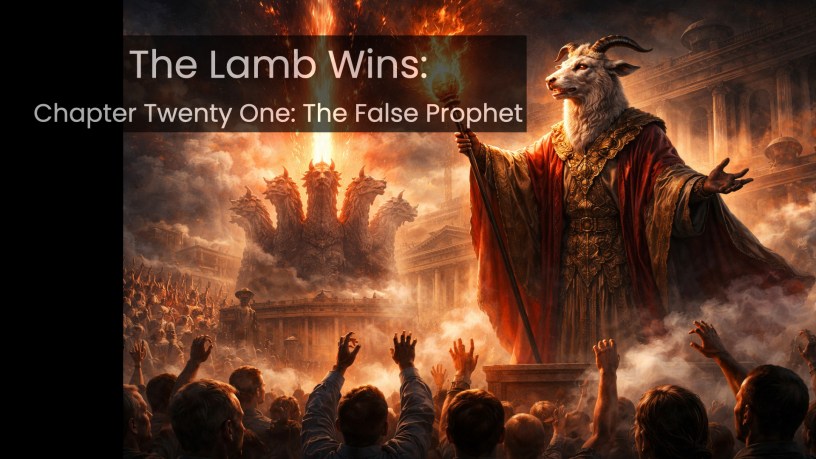
Having met the Dragon (Satan) and the Beast (from the sea) we now turn our attention to the second ‘beast’ (from the land), who is better known as the False Prophet. He is the religious enabler of the political power of the Beast. And just like the Beast there are multiple interpretations of who/what this False Prophet may be.
The account in Revelation is fairly straight forward:
The second beast who is introduced in Revelation 13:11–18, comes from ‘the earth’. He looks like a lamb but speaks like a dragon (a reverse of the hear/see pattern we noticed in Revelation 5). This tricky beast exercises authority on behalf of the first beast and performs religious signs and miracles to deceives the inhabitants of the earth, even to the point of them worshipping an image of the first Beast which this second beast is able to animate.
Then I saw a second beast, coming out of the earth. It had two horns like a lamb, but it spoke like a dragon. It exercised all the authority of the first beast on its behalf, and made the earth and its inhabitants worship the first beast, whose fatal wound had been healed. And it performed great signs, even causing fire to come down from heaven to the earth in full view of the people. Because of the signs it was given power to perform on behalf of the first beast, it deceived the inhabitants of the earth. It ordered them to set up an image in honor of the beast who was wounded by the sword and yet lived. The second beast was given power to give breath to the image of the first beast, so that the image could speak and cause all who refused to worship the image to be killed. It also forced all people, great and small, rich and poor, free and slave, to receive a mark on their right hands or on their foreheads, so that they could not buy or sell unless they had the mark, which is the name of the beast or the number of its name.
In Revelation 16:13 this second beast is named as the false prophet and included in the unholy trinity of dragon, beast, and false prophet. But he is captured in Revelation 19:20 along with the Beast and thrown into the lake of fire. Finally in Revelation 20:10 the whole unholy trinity is judged and their end has come.
- Revelation 13 introduces the false prophet (as the beast from the land)
- Revelation 16 names it as the false prophet
- Revelation 19–20 concludes its destiny
Preterist Post-Millenials (‘that’s SO first century’)
So far so clear. But with nearly 20 centuries of interpretation gone on it’s worth seeing how different elements of the Church have understood the false prophet. And to start us off I want to introduce a new interpreter – the ‘preterist post-millenials’ – a fancy way of saying they think Revelation is pretty much all wrapped up in the 1st Century and after that comes 4 things:
- Gradual Christianisation of the World: The Kingdom of God will expand gradually through the preaching of the Gospel and the power of the Holy Spirit until the “vast majority” of the world’s population is converted.
- A “Golden Age”: Widespread conversion will eventually produce a “Golden Age” in which faith, righteousness, and peace prevail among nations. Christian principles will significantly influence all spheres of life, including law, culture, and social structures.
- The Spiritual Reign of Christ: Christ is currently reigning from heaven and exercising His authority through His Church on earth. He will not return physically until this earthly reign has been successfully established by His followers.
- Final Rebellion and Judgement: At the end of this golden age, there may be a brief final rebellion by Satan, which is immediately followed by Christ’s visible and bodily return, the general resurrection, and the final judgment.
This worldview was really popular in America during the nineteenth century, giving birth to many missionary movements. It synced nicely with philosophy – Hegellian optimism and biology – evolutionary development theory. But it ran aground during the horrors of the Great War (1914-1918).
However it is perhaps strangely having a bit of a renaissance among some of the radical right in the USA who want to set up a ‘theocratic republic.’ Known as Christian Reconstructionists they have shaped a significant part of the homeschooling movement and influenced prominent figures like Pat Robertson and Jerry Falwell.
Academically partial-preterist postmillennialism is well represented by Kenneth Gentry. Gentry sees the False Prophet as mainly being apostate Jewish leadership in the 1st Century (especially the Jerusalem religious authorities) who rejected Jesus, allied with Roman power and persecuted the early church. For the preterist the sea beast signifies Roman imperial authority (seafaring people) and the earth beast / false prophet is the Jewish religious leadership (from ‘The Land’).
However it is not at all obvious that this group did many signs to deceive people, and so Gentry has to say that these are not necessarily supernatural miracles but may be claims to prophetic authority, temple-centred legitimacy and institutional power and coercion. Of course by that reckoning the famous pharisee Saul of Tarsus could have been an archetype of the false prophet before his conversion/calling on the Damascus road which led to him becoming the man we know as St Paul.
For the preterists Revelation’s judgments are mostly behind us as Christ’s kingdom advances in history. The defeat of the false prophet means the collapse of old covenant (Jewish) opposition as the temple gets destroyed and the long-term triumph of the (Christian) gospel. It’s not too hard to see how all this could lead to anti-semitism as the Christians replace the Jews.
As we will see in a later chapter Revelation 19–20 is not read as the end of history, but the beginning of Christ’s reign on earth – the enthronement phase which we are already enjoying.

Left Behind / Dispensational Premillennialism
We get a much more exciting story with the LaHaye Left Behind series. This downplays all symbolism and makes Revelation fit squarely with events in the late-twentieth century (mainly in the USA). For them the false prophet is a literal future individual, a global ‘ecumenical’ religious leader who:
- Works with the Antichrist
- Performs real supernatural miracles
- Leads a one-world religion
- All this is during a 7 year future tribulation (that the church as we know it has been spared from by the secret Rapture of believers)
Amillennial / Idealist – G. K. Beale
Amillenials have life harder than postmillenials and premillenials.
- The troubles are in the past for the post-millenials. They went with the pesky Jewish leaders who rejected Christ. Things can only get better as we move away from that and enjoy Christ’s ever increasing rule here on earth.
- There is a rough future ahead for some in the dispensationalist premillenial worldview, but hey, the ones who realise that have got a ticket out of here! So it’s just about leaving clues and messages for those ‘left behind’ to follow when the planes fall out of the sky. Question: if you are a premillenial should you morally be flying airplanes anyway if you think you might be raptured mid-flight?
- But the amillennials just have a world that can be repetitively tough even if they know from Revelation that the Lamb Wins and they can endure with him. This view was first proposed by Augustine in the fourth century in City of God, and is a widely-held view today.
For amillennials the ‘false prophet’ turns up again and again in any false religion or deceptive ideology that supports idolatrous power. It’s a recurring reality throughout the church age. It can be manifest in all sorts of (mainly religious) people.
Beale agrees that the (earth) Beast contrasts with the (sea) beast/ false prophet. The sea beast is the religious legitimation of the first Beast’s great power. It is a Christian mimic with a Lamb like appearance. But if you listen carefully it has dragon-like speech, and so comes from a satanic source. Its ‘signs’ echo false prophets in Deuteronomy 13. The signs are real, but turn your head away from God.
Historical-Contextual / Pastoral – Ian Paul
Ian Paul broadly aligns with Beale but pushes historical grounding harder. The false prophet is religious authorities giving propaganda that makes the emperor seem god-like. ‘Caesar is Lord’. So likely candidates operating as a false prophet would be imperial cult officials and any compliant religious leaders. The signs can be simply public spectacles and propaganda, not fantasy miracles, and the image of the beast they bring alive would mean animating imperial statues to trick the people that the power there is real.
Something lacking still?
There seems to be something lacking in the accounts that make the false prophet simply a first-century historic figure. Whether imperial cult (Ian Paul) or Jewish leadership (Kenneth Gentry) neither of these seems to fully fit the miracle working, deceiving spiritual force in view here.
The amillennial idea that the ‘false prophet’ turns up again and again in any false religion or deceptive ideology that supports idolatrous power, seems to have significant explanatory power.
The devil/satan is the Dragon behind the scenes, always looking for a Beast (political power) and a False Prophet (religious power) to deceive people into worshipping the Beast, who is in turn dancing to the Dragon’s tune.
Yet we could imagine that in all sorts of situations in history. In fact there are at least 16 which have gained a following. These range religious powers such as Islamic empires as the beast, with Muhammad as the false prophet; and the Holy Roman Empire as the beast with papacy and clerics as false prophet; to tyrannical regimes with their ideologies (like marxism) operating as the false prophet; to more modern interpretations varying from the UN as the beast and secular humanism or interfaith as the false prophet to capitalism as the beast and advertising as the ideology that can be described as the false prophet.

I can remember as a student reading Dr. David Yonggi Cho of Yoido Full Gospel Church in South Korea, who had a premillennial view of the Second Coming of Christ. Like many dispensationalist preachers of his era, he often interpreted the European Union (historically the European Economic Community) through the lens of the biblical “ten-nation confederacy” mentioned in the Book of Daniel and Revelation. He viewed the integration of European nations as a potential precursor to the rise of a global government or the Antichrist. This got less convincing an argument as the EU expanded beyond ten nations! And sadly in 2014, Cho was convicted of embezzling approximately $12 million in church funds. That would probably qualify him as a ‘false prophet’ in someone else’s critique. The point is, it is hard to call it right.
A charismatic approach: Pan-millenial or a key insight?
Paul Langham at New Wine described himself as a ‘pan-millenial: it will all pan out in the end!’ There’s merit in that. It has humility. But are there take homes for charistmatics from all this study of the Beast and the False Prophet? Here are a few ideas:
1. Assumption: Personal evil operates through structures and people
A charismatic deliverance ministry will assume that evil is personal (demonic, intelligent, deceptive); systemic (embedded in cultures, institutions, habits). That Spirits seek embodiment and authority, and that their authority is often mediated through leaders, movements, and ideologies. So they can have multiple manifestations.
2. Reading Revelation Through a Deliverance Lens
The Beast represents coercive power animated by spiritual evil and operates through empires, states economic systems and violent or idolatrous leadership
The False Prophet represents deceptive spiritual authority and operates through religious leaders and ideological systems as well as false teaching, and uses signs, rhetoric, or ‘spiritual experiences’ that legitimise the Beast.
These are things we see all the time in the deliverance ministry.
3. Why the same spirits can reappear across history
In Luke 11:24–26 spirits leave and return. In Ephesians 6:12 there are rulers, authorities, powers in Daniel 10 there are territorial and political spirits and in Revelation 17:8 ‘the beast was, is not, and is to come.’ These suggest that the same demonic intelligences can withdraw, reconfigure and re-emerge in new historical settings
So Emperor Nero, twentieth-century totalitarian regimes and even modern ideological movements can all be genuine manifestations without exhausting the prophecy – operating under the ‘spirit of the beast’ or the ‘spirit of the false prophet.’
4. Discernment over identification
But it should be noted that it is often a waste of energy in deliverance ministry to overfocus on naming the spirits. Naming can breeds fear, fixation, and distraction, and the Bible emphasises discernment of spirits, not prediction of villain.
The better question is not: ‘Who is the Beast?’ But: ‘Where is beastly power operating now, and how do we resist it in Christ?’
5. How a final intensified incarnation of the Beast/False Prophet could still makes sense
Charismatic theology also takes seriously eschatological intensification. Key texts like Matthew 24 suggests an escalating deception, 2 Thessalonians 2 that lawlessness is still to be revealed and there is something still to come in Revelation 19 about a climactic confrontation
So there can be a concentration of previously dispersed spiritual activity, a greater embodiment in specific leaders or movements and we should expect there to be a final attempt to counterfeit Christ’s authority
What has been operating diffusely may one day operate centrally.
6. Jezebel as an analogy
A controversial bit of charismatic teaching is about the so-called Jezebel spirit. She was a historical queen, a named spirit in Revelation 2, seems to be a recurring pattern in church life, and if that is the case is clearly not identical in every manifestation. But deliverance ministers will tell you the Jezebel influence is recognisable by fruit and behaviour. This could be true of the Beast and False Prophet too. If the Beast is a ruling spirit of domination and False prophet is a ruling spirit of deception, then both can inhabit many hosts, yet may well culminate in a final expression.
Summary
A charismatic deliverance ministry can understand the Beast and False Prophet as recurring spiritual powers that seek embodiment through people, movements, and systems throughout history, especially where coercive authority is religiously legitimised. These powers may be genuinely defeated again and again by the work of Christ, yet Scripture also allows for a final, intensified manifestation in which dispersed deception becomes concentrated. The ministry response is not speculation but discernment, prayer, repentance, and faithful witness to the Lamb.
And that all seems worth learning!
Read More in this Series
The Lamb Wins Whole Series Catch Up : Introduction: Chp 1: Hope is Here | Chp 2: First, Love: Ephesus | Chp 3: Fear Not: Smyrna | Chp 4: I Know: Pergamum | Chp 5: Tolerate This: Thyatira | Chp 6: Wake Up: Sardis | Chp 7: Hold On: Philadelphia | Chp 8: Knock, Knock: Laodecia | Chp 9: What Must Soon Take Place | Chp 10: Holy Forever | Chp 11: Most Blessed | Chp 12: One That Was Slain | Chp 13: Come Home | Chp 14: Sun Forbear to Shine | Chp 15: 144000 | Chp 16 Sound of Silence | Chp 17: Spiralling Down | Chp 18 Two Witnesses | Chp 19 The Rapture | Chp 20 The Beast
Subscribe Below
If you have enjoyed this post why not check out somauk.org/stories and maybe even pay it forward by sharing the post and maybe take a moment to bless a brilliant charity? SOMA UK relies of the generosity of churches and supporters to fulfil our marvellous ministry – encountering God globally. Every donation goes a long way.
To support our ministry it’s www.somauk.org/donate
 Your name is like honey