
It costs around £144000 to run a day at General Synod, but that number has a much more significant purpose in Revelation 7. I don’t often reach to the General Synod of the Church of England as an example of theology and faith, but the honest truth is I encountered some excellent thinkers and practitioners there. This was true both in my stint as a young clergy representative for Lichfield Diocese, and more recently on the chaplaincy team when the Synod has met in London.
As a young clergyman (27), I was called to speak regularly by Chairs looking for some age diversity. I developed a reputation for positive anecdotes and some light entertainment and was a fairly safe bet to call on. I quickly discovered that the important work went on behind the scenes, and under Mark Ireland’s tutelage learnt to ask questions, join committees and even to lead a diocesan and private members motion. I was sad to leave, and delighted to reengage in the current quinquennial on the voluntary support team. Not least as it is a great place for networking and several of my SOMA UK leadership team and other members have been recruited there!
I got to serve in my 20s-30s at a time that debates were infused with theology. Archbishop Rowan would raise the tone simply by standing, and the likes of Anthony Thistleton and Paula Gooder would vie with Richard Burridge for the accolade of ‘heavy weight theological contribution of the day award’ – if Christina Baxter let them win that is. It was an educational experience for us all.
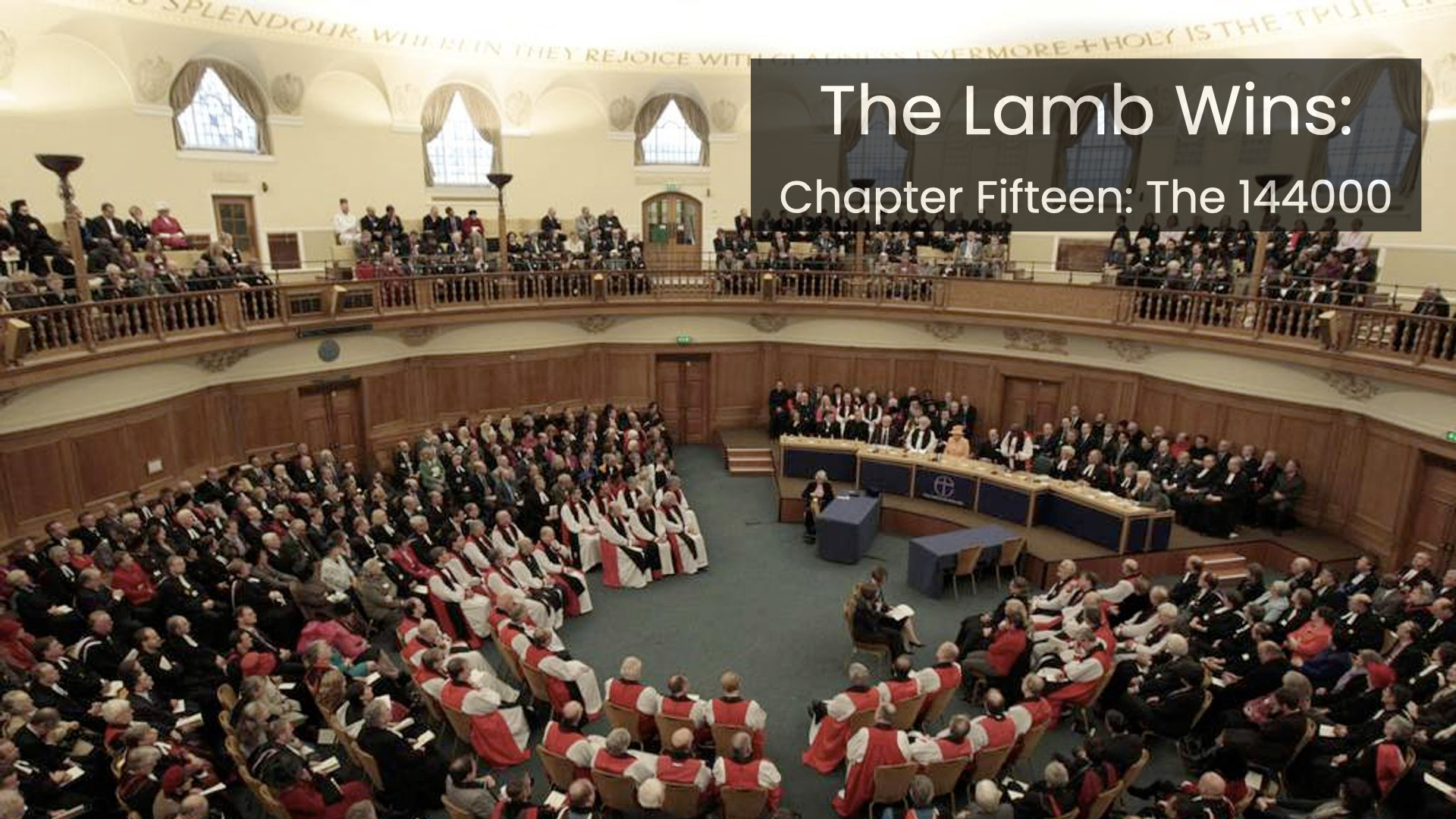
Among the Bishops was NT Wright, who may have been the only person who could fully understand the Archbishop whose intellect seemed to live on a plane above it all. Not a bad position to preside from, especially given his humility and grace. It’s nice to remember some of those days.
Behind the scenes I was dimly aware that there was a Doctrine Commission and a Faith and Order Commission, where other theologians would be drawn in. The likes of Richard Bauckham would contribute. In front of the synod or media the likes of Bishop Michael Nazer Ali could lecture at a whim on almost any subject and would dazzle with his display. It was quite a heritage to draw upon from.
I mention this as I was trying to get my head into Revelation 7 and realised that this is a passage I think they would for the main part agree furiously on. Helped as ever by reading another more recent Synod member, Ian Paul, the well-known blogger and author, I began to think about how NT Wright, Richard Bauckham, Paula Gooder, Anthony Thisleton, Rowan Williams and Ian Paul himself might say if they were asked to explain this chapter at Synod.
A General Synod Debate on Revelation 7:
Motion: That this house should spend a day trying to understand what Revelation 7 is all about, with reference to the Seals, 144000, multitude and Lamb who behaves like a shepherd.
The accompanying literature would point out that as this motion was asking for no further work it would be well worth the Synod time and at a cost of just the day rate of £144000 one of the cheapest things Synod had put its mind to.
The chair might first call on Paula Gooder:
Paula would open up the chapter for us as a pastorally rich, hope-giving interruption in the flow of judgement. She would encourage Synod that Revelation 7 reassures anxious believers and anchors them in God’s purposes rather than in fear.She always struck me as someone who showed the benefit of having EQ in academia, and might point out that Revelation works emotionally as well as theologically. Chapter 7 comes between the opening of the sixth and seventh seals, and she would stress that this is deliberate: it is a breathing space where the question “Who can stand?” (6:17) is answered. God’s people are not forgotten or abandoned.1
At this point Richard Bauckham would be quoted from a committee member in the Synod to agree furiously. They might point out that Revelation 7 interrupts the opening of the seals. The sixth seal has unleashed cosmic disorder. Kings and slaves alike cry out in terror:2
“The great day of their wrath has come, and who can stand?” (Rev 6:17)
Like Gooder, the speaker agrees that Revelation 7 exists precisely to answer this question. It does not move the story forward in time; it deepens it theologically. The pause is deliberate. Before judgment resumes, John is shown who belongs to God.
Then Ian Paul would take the depth and make it practical. Giving an illustration from his church in Nottingham (or his bouncy dog Barney) he would repeatedly emphasise that this chapter is not about chronology but reassurance.3 Revelation is not offering Christians a timetable; it is shaping their imagination. The question is not when the end comes, but how God’s people endure in the meantime – just like his dog endured when…
The Bishop of Durham (2003-2010), Professor N. T. Wright is on his feet. The Chair catches his eye and calls him, with a strict 3 minute time limit. He starts to place this interruption in the opening of the seals firmly within the wider biblical story. Moments of apparent chaos have always been the context in which God reaffirms his covenant faithfulness — from exile to the cross. Revelation 7 reassures the church that history is not slipping out of God’s hands, even when it feels like it.
So far the mood in the chamber is encouraging. But we come to the first knotty issue of the day, one that divides those Left Behind from the academically initiated. The 144,000. (A number some of us remember best from an overlong discussion with a Jehovah’s WItness knocking on our door – where it wasn’t obvious if being their 144,001 convert would be a good thing for you or them).
The passage reads:
“Do not harm the land or the sea or the trees until we put a seal on the foreheads of the servants of our God.” Then I heard the number of those who were sealed: 144,000 from all the tribes of Israel: From the tribe of Judah 12,000 were sealed, from the tribe of Reuben 12,000, from the tribe of Gad 12,000, from the tribe of Asher 12,000, from the tribe of Naphtali 12,000, from the tribe of Manasseh 12,000, from the tribe of Simeon 12,000, from the tribe of Levi 12,000, from the tribe of Issachar 12,000, from the tribe of Zebulun 12,000, from the tribe of Joseph 12,000, from the tribe of Benjamin 12,000.
A background paper accompanies this section including contributions from the theologians we have just met. This is summarised by a variety of speakers who catch their eyes as they quote them:
Few elements of Revelation have been more misread than the number 144,000, calls the first speaker, claiming a trilogy of sources to support her point: ‘Bauckham, Paul, and Wright are unanimous,’ she cries out, ‘this is symbolic, not literal.’
A detailed speech then walks through their main points:
The number is densely layered: twelve tribes, twelve apostles, multiplied and magnified. Bauckham points out that John is not counting individuals but invoking the imagery of a military census from Numbers 1.4 Israel is being numbered for battle. But this “army” is deeply strange.
Ian Paul draws attention to the irregular tribal list. Dan is missing. Joseph appears alongside Manasseh. Judah is listed first. This is not a genealogical record; it is a theological signal. Any attempt to read this as a literal future remnant of ethnic Israel simply does not do justice to the text.5
Wright reframes the issue in covenantal terms. Israel was chosen not for privilege but for vocation — to be the means by which God would bless the nations. Revelation does not discard Israel; it redefines Israel around Jesus the Messiah.6 The 144,000 represent the renewed people of God, Israel-shaped but Messiah-centred.
There is light relief then when a young deacon jumps up and tells his holiday story for visiting Israel last year. But the point is carried and there is a clear sense that the 144,000 is symbolic, a strange army, not a genealogical record at all, but something else…
The Chair moves the debate on to an amendment asking Synod to affirm that the ‘great multitude’ in Revelation was one that ‘no-one could count, from every nation, tribe, people and language.’ Before the Chair can dismiss this motion as spurious given it was an exact quote from Scripture and we all believe that, 25 plus people stood ensuring it was debated on. Numerous personal stories were told about cousins, missionaries, friends, prayer partners they knew from various corners of the world, and a rally cry was given from a mission agency rep to remind us to keep supporting the Partners in World Mission. The theologians sat and listened.
Eventually Bauckham was quoted again by a budding theology graduate who had actually met him. He pointed out, between shakes, that Bauckham’s most influential insights concerns Revelation’s repeated hearing/seeing pattern. John hears one thing, then sees something that interprets it. In what became a deeply moving speech the young ordinand compared Revelation 7 to Revelation 5. In Revelation 5, John hears of the Lion of Judah and sees a slain Lamb. The same pattern appears in Revelation 7. John hears the number of the sealed — 144,000 — and then sees: ‘a great multitude that no one could count, from every nation, tribe, people and language.’ (Rev 7:9) A Lion becomes a Lamb. A large national crowd becomes a multitude from the nations.7 He sat down after announcing that he too was called to the nations, and had a title post in Bermuda to move to.
Ian Paul somehow managed to get called again in the debate, due to an unsuspecting Chair. He brought the applause for the intrepid wannabe curate to order elaborating on the Bauckham quotes in the order paper. ‘These are not two groups. They are the same people, viewed from two angles.’ With an extended side-swipe at the Left Behind series Ian Paul continued to dismantle the popular but flawed interpretation that separate Jewish and Gentile believers or create spiritual hierarchies within the church. The people of God are simultaneously Israel-shaped and globally diverse.
Bishop Tom Wright spotted that the Chair was out of control and rose again to press the theological implication further: the promise to Abraham that he would be a blessing for the nations is being fulfilled before John’s eyes. This is not Plan B; this is the plan reaching its goal. He went on to explain that Bauckham’s reading of the 144,000 as a symbolic army is crucial and that while revelation uses military imagery, it radically redefines victory. It is an army that conquers not by violence but by testimony. The Lamb conquers by being slain. His followers conquer “by the blood of the Lamb and by the word of their testimony” (Rev 12:11).8
Ian Paul asked under a point of order whether Wright agreed that Revelation 7 is not a call to retreat from the world, but to resist its idolatrous demands — especially the temptation to secure safety through compromise. To which NT Wright concurred, but framed this as vocation. The church shares in Israel’s priestly calling: standing between God and the world, absorbing hostility, and bearing faithful witness for the sake of others.
After a brief coffee break the Synod returned to the main motion.
Anthony Thiselton then stood and made it crystal clear that being ‘sealed’ does not mean being spared from suffering, giving two very meaningful brief examples of this. The white robes come after suffering, and this pastoral reassurance is not a denial of pain, but a hope that suffering does not have the final word.
Christina Baxter agreed and pointed out that Revelation 7 does not justify suffering or render it necessary. But the text places suffering within a moral universe ordered by God’s faithfulness, where endurance is not stoicism but participation in Christ’s own life.9 She then pointedly informed the Chair that it was time we heard from the Archbishop, who was peering over his eyeglasses and under his animated eyebrows and looked poised and grateful for this motion for closure.
Rowan Williams stood up at his personal lectern. Uttered his Synod number: ‘double-O-one’ and brought the debate to a closure.
After summarising the debate graciously he elevated the room of theologians and those just hungry for dinner to see that:
1. Revelation 7 trains us to see differently10
Scripture re-educates our imagination. Revelation 7 does not simply describe a future scene; it purifies our vision. The church learns to see itself not as a marginal or threatened group, but as already caught up in God’s worship and joy—even when history suggests otherwise.
2. The multitude is discovered, not achieved
The multitude appears rather than being assembled by human effort. This is not the result of successful mission strategies or moral achievement, but of God’s sheer generosity. Salvation is something we find ourselves inside, not something we construct.
3. The Lamb at the centre reshapes power and desire
He then lingered over the paradox of the Lamb who shepherds. Authority flows from self-giving love, not domination. Revelation 7 quietly but radically reorders what we long for, turning us away from control and towards communion.11
4. Worship is the most truthful response to suffering
Worship is not an escape from pain but the place where pain is spoken truthfully before God. The palm branches, the white robes, and the cries of praise do not deny the great ordeal; they show that suffering has been taken up into God’s life without being explained away.12
5. “God will wipe away every tear” is a promise of intimacy
Slowing down at the final line of the passage, Rowan looked deeply in the eyes of several people in the audience he knew were in pain. He told them that the promise is not just the removal of suffering but God’s closeness. The image is tactile and personal: God does not send comfort from a distance but comes near enough to touch the face of the grieving.
The Synod then stood as one. Prayer the ‘Our Father’ together and went to tea. Mindful that they were part of a much bigger story.
But a few went home to watch Left Behind (just one of whom was a lifelong Nicholas Cage fan). And several found they had slightly irate phone calls that week from parishioners on a mailing list of a charity that had been watching the proceedings carefully. One vicar found himself recommending people rewatch the debate on YouTube, before chuckling to himself in amusement that he had done that.
[disclaimer: All opinions, mischaracterisations and any nonsense is entirely my own]
Read More in this Series
The Lamb Wins Whole Series Catch Up : Introduction: Chp 1: Hope is Here | Chp 2: First, Love: Ephesus | Chp 3: Fear Not: Smyrna | Chp 4: I Know: Pergamum | Chp 5: Tolerate This: Thyatira | Chp 6: Wake Up: Sardis | Chp 7: Hold On: Philadelphia | Chp 8: Knock, Knock: Laodecia | Chp 9: What Must Soon Take Place | Chp 10: Holy Forever | Chp 11: Most Blessed | Chp 12: One That Was Slain | Chp 13: Come Home | Chp 14: Sun Forbear to Shine
Subscribe Below
If you have enjoyed this post why not pay it forward by sharing the post and maybe take a moment to bless a brilliant charity? SOMA UK relies of the generosity of churches and supporters to fulfil our marvellous ministry – encountering God globally. Every donation goes a long way.
To support our ministry it’s www.somauk.org/donate
- Gooder, P. Searching for Meaning: An Introduction to Interpreting the New Testament. SPCK/Canterbury Press, 2008. ↩︎
- Bauckham, Richard, The Theology of the Book of Revelation, Cambridge: CUP, 1993, ch. 4.
↩︎ - Paul, Ian, Revelation, Tyndale New Testament Commentary, IVP, 2018, ch. 5. ↩︎
- Bauckham, Richard, The Climax of Prophecy Edinburgh: T&T Clark, 1993, 215–238. ↩︎
- Paul, Revelation, 159-160. ↩︎
- N. T. Wright, Revelation for Everyone SPCK, 2011, 65–70.
↩︎ - Bauckham, Climax of Prophecy, 232. ↩︎
- Bauckham, Theology, 70–72. ↩︎
- Baxter, C. Articles on Scripture, church identity and moral formation.
↩︎ - Vines, L. “Rowan Williams’ theology of revelation.” Journal of Anglican Studies, 23(2), 2024.
↩︎ - Williams, R. Being Christian: Baptism, Bible, Eucharist, Prayer. Eerdmans, 2014. ↩︎
- Williams, R. On Christian Theology. Wiley‑Blackwell, 2022. ↩︎
 Your name is like honey
I do enjoyed this ; entertaining and helpful
LikeLike