There is a verse of John Newton’s hymn, Amazing Grace, that has had a renaissance through Chris Tomlin’s chorus: Amazing Grace (My Chains Are Gone). Written in 1779 it reads:
“The earth shall soon dissolve like snow, / The sun forbear to shine; / But God, who called me here below, / Shall be forever mine”.
In today’s reading from Revelation 6 we get to see one of the images behind that verse (see also 2 Peter 3:10, Mark 13:24 and Isaiah 13:10; 34:4).
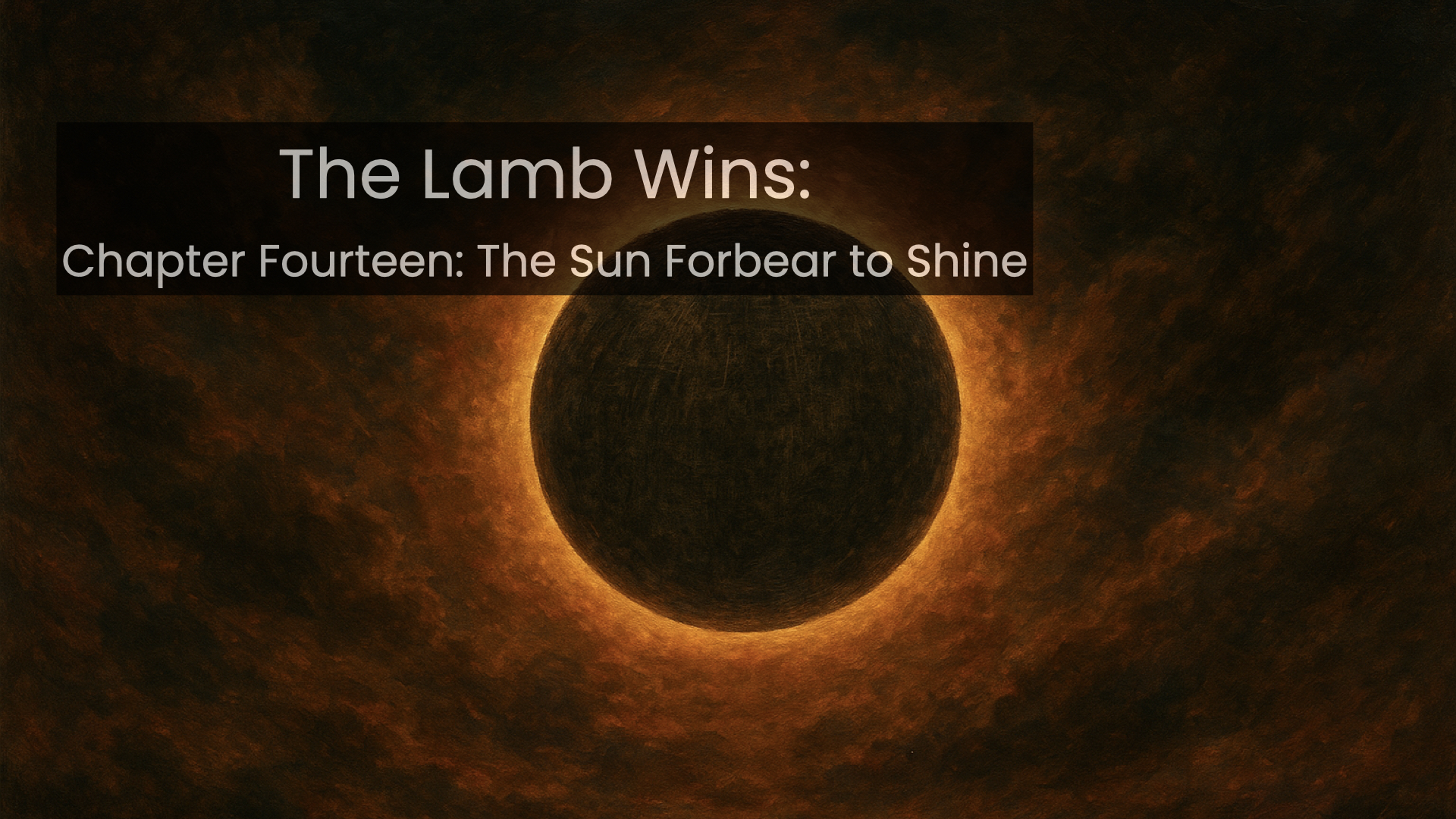
‘I watched as he opened the sixth seal. There was a great earthquake. The sun turned black like sackcloth made of goat hair, the whole moon turned blood red,and the stars in the sky fell to earth, as figs drop from a fig tree when shaken by a strong wind. The heavens receded like a scroll being rolled up, and every mountain and island was removed from its place.’
A cosmic shakeup. The sixth of seven seals opened by the Lamb. It leads to:
‘Then the kings of the earth, the princes, the generals, the rich, the mighty, and everyone else, both slave and free, hid in caves and among the rocks of the mountains.They called to the mountains and the rocks, “Fall on us and hide us from the face of him who sits on the throne and from the wrath of the Lamb! For the great day of their wrath has come, and who can withstand it?”’
It’s a great chapter I would normally skip right over! Mainly because these two sections aren’t even the hardest things to understand. But I visited a friend in Oxford recently who encouraged me to carry on… and I’m glad I have done so.
I’ll be back?
To make sense of the sun turning black and stars falling from heaven we can either tune our imaginations through the lens of a James Cameron horror classic, and visualise the rise of AI machines raining nuclear missiles all over the earth, or (better!) we can remember that this book was written to a first century church who had never heard of airplanes let alone inter-continental ballistic missiles. But they had read the Old Testament, and they had studied carefully the words of Jesus about the last days (in Mark 13 and Matthew 24).
This chapter begins not with anarchy and a world out of control, but a very deliberate act by the Lamb. That is an act of Jesus. He opens the seals on the scrolls that we have just read everyone has wanted him to open and he – as the Lamb who had been slain – was the only one worthy to open. Terrifying events happen as a result of each seal being opened, but they only happen because Jesus opens the seals. To put it another way: The opening of the seals is not an accidental prelude to chaos. Each seal is opened by the Lamb, who has already been identified as both slain and victorious. This immediately tells us that the suffering described here is not outside God’s sovereignty—but neither is it arbitrary punishment.
History is not chaotic.
Suffering is not random.
Jesus reigns—even when the world looks out of control.
This immediately reframes fear into confidence. Revelation does not present a distant, wrathful God, but a crucified Messiah who is already enthroned. And those waiting on earth can be confident in affirming: he will be back.
Apocalypse Now
We then read of the ‘Four Horsemen of the Apocalypse.’ These are basically terrifying and if you are reading them as future events it would be enough to make you store up your supplies in an underground bunker and form your own militia.
But the key to understanding them is that they were not future, but familiar to John’s first readers. They would have recognised them instantly.
They represent:
• Military conquest and imperial ambition
• War and social breakdown
• Economic exploitation and scarcity
• Death as the inevitable consequence
All of these were grim realities of life under Roman rule.
What it is not saying is that one day there will be conquest, war, scarcity and death, but that you are (already) having to live with this all the time. This is what the world looks like when humanity rebels against God. These are judgements that we should pay attention to. They should help us realise our need of a worthy ruler – the Lamb.
But the readers would also notice the restraints—God is allowing the world to feel the consequences of sin while still holding things back. Terrible as it seems, it is not like the days of Noah, where everything was destroyed. Now the impact of these horsemen is limited to a quarter of the world’s population at any given time. God’s judgement in Revelation is often partial and provisional, intended to provoke repentance rather than total destruction. The Lamb opens the seals, but the end is still held back.
This is God ruling patiently, allowing sin to work itself out, but not without restraint.
This explains the headlines. We live in a world where these horsemen have been released. But they can’t ride forever. This is not God losing control. It is God waiting. Biding his time before his final judgement puts an end to all tears, and pain and death. The question that is building up is ‘How Long?’
Revelation is describing the world we already know. It is not predicting something unprecedented. It echoes the language of the prophets like Zechariah, reminding us that this is God allowing the consequences of human rebellion to be seen. A prodigal son story on a cosmic scale. But what will it take for humanity to ‘come to our senses?’
How Long?
The martyrs cry: ‘How long, Sovereign Lord?’ They are asking for the holy and true God to judge and avenge their blood. God welcomes this prayer. We are supposed to lament injustice and persecution. More controversially, we are supposed to long for judgment and for justice. The martyrs join in the prayers of the prophets and the Psalms as they cry out for intervention. They are not rebuked for asking but affirmed.
God’s answer is to give them robes, tell them to wait and explain that there are more martyrs to come. Their vindication is delayed—not denied—because God’s redemptive purposes are not yet complete.The delay is not weakness; it is mercy. Seen from heaven’s eyes, history is not driven by dominions and power, but by divine patience.
God is giving time—for the gospel to go out, and for more to repent. But there will be a great cost for that gospel.
This sixth seal leads to a grand equalisation of society. Kings, princes, generals and common people all hiding away from the results of a great earthquake. The sixth seal.
I’ve visited a few countries recently where elections were due, or over due, and the fear of the people was palpable. I’ve listened to first hand accounts of brutal regimes controlling populations through baying mobs or direct interventions. I’ve sat in family discussions as to whether equality is ever really possible. I’ve talked to people whose families have been martyred for their faith. In each case there has been an underlying question: ‘How Long?’ until this is sorted out. Or an even deeper one: ‘Can anything ever change?’
The sixth seal: Sun, Moon and Stars…
The book of Revelation is apocalyptic prophecy, which means:
It communicates truth through vivid, symbolic imagery
The images are meant to evoke meaning, not provide a photographic prediction of future events
Almost everything in Revelation is recycled Scripture, especially from Isaiah, Ezekiel, Joel, and Daniel
Ian Paul and Tom Wright both remind us we need to start from what would these images mean to a first-century Jewish-Christian reader who knew their Bible prophesies?
They would see cosmic collapse language as language of judgment. The earthquake, darkened sun, blood-red moon, falling stars, and rolled-up sky are standard prophetic metaphors for God’s judgment.
In Isaiah 13:10 (judgment on Babylon) Isaiah 34:4 (judgment on Edom) Joel 2:10, 31, Ezekiel 32:7–8, The sun going dark does not mean the literal sun collapses, stars falling does not mean astrophysics breaks. The language means the political, social, and spiritual ‘cosmos’ are being dismantled.
For first century Christians living under the tyrannical terror of Rome that cosmos meant the Roman imperial system. A violent power structure opposed to God’s kingdom, where God’s people were being horrifically persecuted (as seen in the seven letters in Revelation 2-3).
The problem isn’t earthquakes — the problem is that those who thought they ruled the world discover they don’t.The breaking of the sixth seal means human systems that claim ultimate power are exposed as fragile, and will face God’s judgment arriving not quietly, but publicly, unavoidably, and terrifyingly. Kings of the earth… hid in caves… calling to the mountains, ‘Fall on us!’.
And like the other seals these are scenarios we see again and again in politics and history. Terrorists dying in caves. Fuhrers in bunkers. Politicians exposed. Princes removed from positions. Empires wane. CEOs fall. These rules and Kingdoms come and go. The sun, moon and stars of each era are no more. Yet the Lamb stands forever.
What humans thought was just the way things are time and again proves to be temporary, when you roll up the heavens like a scroll and see what is really going on. The powers that looked so stable and ordered and no longer fixed. Caesar is a footnote in history. The Lamb Reigns.
Revelation 6 is not about the universe ending yet; it’s about the unveiling of reality. History continues in Revelation 7-20. The new heaven and new earth are still to come. It is a series of real judgments and a terrifying unmasking of power, but it is not yet the final judgement, that heralds in the new creation of Revelation 21–22.
What did Jesus say?
In fact Revelation 6:12–14 is consciously echoing Jesus’ own apocalyptic teaching in Mark 13.
As Ian Paul helpfully points out:
Jesus in Mark 13:24–25 says:
“The sun will be darkened, and the moon will not give its light; the stars will fall from the sky, and the heavenly bodies will be shaken.”
That language is almost identical to Revelation 6:
Darkened sun
Altered moon
Falling stars
Shaken heavens
John did not invent this imagery — he learned it from Jesus.
And Jesus himself was drawing on the Old Testament prophets, not predicting astrophysical collapse. So Mark 13 is primarily about the destruction of Jerusalem in AD 70, not a distant end-of-the-world scenario, as Jesus explicitly refers to the Temple’s destruction (Mark 13:1–2), he warns this generation will see these things (Mark 13:30) and the language mirrors OT judgments on cities and nations
And when Jesus says ‘the sun will be darkened,’ he means: the religious and political world centred on the Temple is coming to an end, and a whole way of structuring God’s people is being dismantled. This shows that cosmic language describes covenantal collapse.
Revelation 6 works the same way — but on a larger canvas
Mark 13 describes a specific historical judgment (Jerusalem)
Revelation 6 describes the same kind of judgment pattern, now extended to the Roman imperial world
It is the same language, with the same meaning, but a wider scope.
In both cases:
God judges oppressive systems
What feels like “the end of the world” is actually the end of their world
So the ‘sun may soon forbear to shine’ (or at least be darkened like sackcloth made of goat hair) may be true multiple times throughout history. And that judgement may be coming to a human leader near you sooner than you think. So take courage. He has got this. In the new heaven and new earth there will be no more sun. He will be all the light we need.
If you have enjoyed this post why not pay it forward by sharing the post and maybe take a moment to bless a brilliant charity? SOMA UK relies of the generosity of churches and supporters to fulfil our marvellous ministry – encountering God globally. Every donation goes a long way.

 Your name is like honey