
I had an interesting exchange with our former lodger yesterday. He had been a student worker at a large central London Anglican church and was exploring ordination. But over a two year period he felt drawn back into Roman Catholicism, having spent two formative years working in a Catholic school. His ‘conversion’ to Catholicism became part of the statistics of the Quiet Revival, and it made me chuckle when the ‘revival’ going on at the Catholic church he was confirmed into got promoted at the leadership conference of the church he was about to leave as an example of how their ecumenical resources were working.
He is now a University lay chaplain and very articulate on the Catholic faith. Although ‘born again’, charismatic and evangelical, he felt drawn to the historical rootedness and depth of worship, as a contrast to a lighter, more entertainment orientated, approach he had experienced elsewhere. He wanted to be challenged intellectually and in spiritual rigour by his faith.
Yesterday’s Times had an article about a church restoration in Seville. ‘Virgin Mary receives immaculate restoration after botched repair: Gone are the false eyelashes and doll-like features as the treasured statue of Seville is returned to its former glory.’ It was accompanied by a fairly garish picture of a gold clad statue of Mary, in front on an altar, looking enthroned I am guessing as a Queen of Heaven with crowds flocking to photograph her image. Not the sort of thing that seemed to have much intellectual or spiritual rigour behind it.
I had seen an attack piece online from another contact, who reposted the article saying:
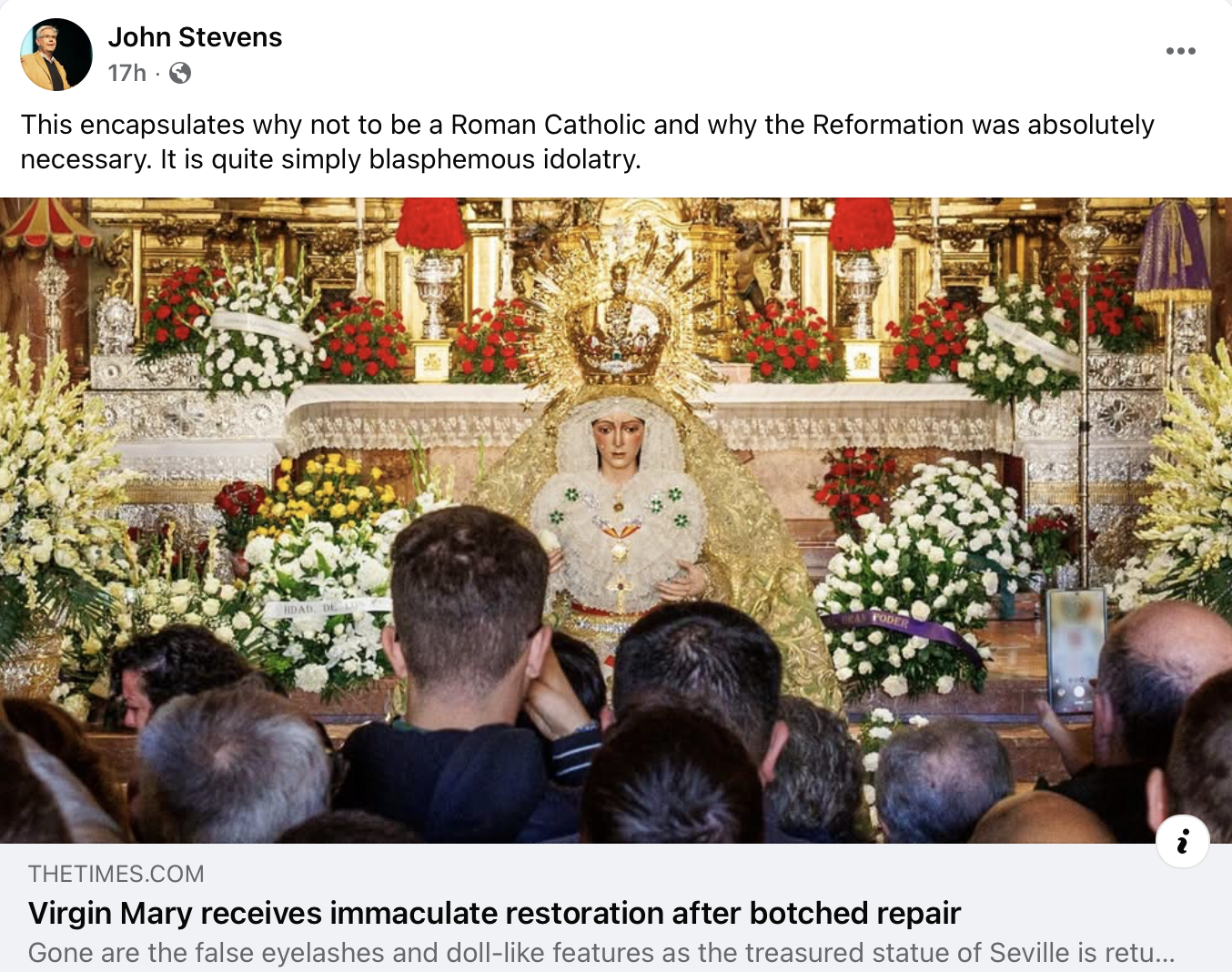
Sympathetic to the critique, I forwarded it to Dan to see if he could defend his denomination against such excesses, knowing he was always game for an answer. Sure enough he replied:
If you could kindly leave a comment with all the Marian typology in scripture that would be much appreciated, (with the grinning emoji that looks like it has been sweating that my AI tells me is used by GenZ to mean ‘embarrased/stressed but coping’ 😅
I told him I wouldn’t know where to start on Marian typology! This then led to a typically interesting and undefended exchange with Dan where he began pointing out a few possibilities, I remembered what my SOMA colleague and theological college vice-principal Helen Collins had said in Jonglei, South Sudan in her excellent bible studies on Mary at our conference, and then finally Dan giving me something to read from the Diocese of Fort Worth, where the adult catechist Lucas Pollice invokes people to ‘ignore the two extremes:’
Pollice argues that Catholics worship only God; they do not worship Mary. But they give Mary an exalted honour because of her exceptional holiness and her unique role in God’s plan of salvation. He distinguishes between three Latin terms Latria, Dullia and Hyperdulia.
Latria is the Latin word for “adoration or worship.” Adoration, worship, and homage are reserved for God alone. Dulia is the Latin word meaning “veneration.” We venerate, or give honor, to a created person due to their excellence or virtue. We do this all the time with historical figures. We honor those who have fallen in battle or given their lives in the line of duty. Hyperdulia is an exalted level of honor given to Mary because of her exceptional holiness and her unique role in God’s plan of salvation as the Mother of God. The Bible tells us that all generations will call Mary blessed (Luke 1:47–48).
Our veneration of the saints does not end with them, but ultimately gives glory to God and fosters a greater union with Him, because it reveals to us His saving power and spurs us on to strive for greater holiness and communion with Christ. Far from worshipping saints, we honor them and look up to them so that we may better worship and love God.
I’m not convinced as when you have got the Sun, why gaze on the moon? Yes, saints may reflect a greater light, but we usually see the moon when we are in darkness. When we come into the Light it eclipses all other ‘lights’. How much more then is the Son greater than any created being, saint or otherwise.
In Revelation 4 our eyes are lifted directly to God. The 24 elders (who perhaps represent the saints) can do little else but join ‘the living creatures’ (representing all of creation) in worship. They fall down before God’s throne, and lay down their crowns:
Each of the four living creatures had six wings and was covered with eyes all around, even under its wings. Day and night they never stop saying:
“‘Holy, holy, holy is the Lord God Almighty,’who was, and is, and is to come.”
Whenever the living creatures give glory, honor and thanks to him who sits on the throne and who lives for ever and ever, the twenty-four elders fall down before him who sits on the throne and worship him who lives for ever and ever. They lay their crowns before the throne and say:
“You are worthy, our Lord and God,
to receive glory and honour and power,
for you created all things,
and by your will they were created
and have their being.” [Revelation 4:8-11].
Created things give all glory, honour and power to the one who Created them by his will and sustains them in their being. Not only the “Lord and God” commander of the world, but the originator of the whole thing. His glory far outstrips that of any human leader (Roman Emperors calling themselves ‘Lord’ are in view here), that even those who get close to his throne find themselves bowing down night and day. He alone deserves the glory.
It is true that over the page in Revelation 5:8 these 24 elders (24 for 12 Old Testament and 12 New Testament saints) are holding golden bowls full of incense, which are the prayers of God’s people. These are then given to an angel in Revelation 8:3 who offers them on a gold altar in front of God’s throne as a sweet smelling smoke offering. So they have a role in heavenly worship, presenting prayers to God. And they do have crowns to lay down. They do have purpose, and they do have honour.
I recently went to a celebratory meal for Richard Izard, a friend who had been given an MBE for his work with the aid charity Worldvision. His 16 year old son was beaming with pride. There is something wonderful about reflected glory. I feel honoured when I hear someone honour one of my loved ones. I find myself reflected well on by their achievements. It would be strange if we weren’t called to honour those that the Lord honours. When Mary said ‘all generations will call me blessed’, it would be reasonable for us to pause to make sure we are a generation who does that.
But when you are caught up in Latria (worship) of the One on the throne, you better make sure your Dulia (honouring) or Hyperdulia (exalted honouring) of created beings is not blasphemous.
So whilst I concur with John Stevens that the enthroning of a golden statue of Mary as Queen of Heaven in front of an altar should trigger a rally cry for a Reformation for anyone who has not had one yet, nevertheless I come away this advent with two reflections on Mary that might have passed me by if I hadn’t dumped his disdain on Dan.

The first is who she represents. The earliest NT reference to Mary comes in Galatians 4:4, which simply says: ‘God sent his Son, born of a woman’. In South Sudan Helen Collins’ bible readings on Mary elaborated on this. Helen pointed out that even in the gospels Mary is introduced without reference to whose daughter she is. The point being that in some way she represents every woman (and every man) who will become Christ-bearers by accepting Christ into their hearts through faith. ‘In John’s gospel Mary is not named at all which can be read to imply a similar thing.’ She is a new Eve. A woman who acts in faith, not fear. A herald of a new age. The bringer of good news that will replace old curse and law.
The second is her lack of fear. She is the only person in Scripture who an appearing angel does not have to say ‘Fear Not’, to straight away, but rather begins “Greetings, you who are highly favored! The Lord is with you.” She only gets told to ‘fear not’ when she gets told her divine mission. [Lk 1:27-28].
And if I wanted to get my brain cells really running into overdrive I might pretend I know something about science. I am told that a baby’s and mother’s DNA (cells) get mixed during pregnancy through the placenta, a phenomenon called fetal-maternal microchimerism where cells travel back and forth and can persist in the mother’s body for decades, even integrating into organs like the brain, potentially aiding in tissue repair or, in some cases, contributing to autoimmune conditions. It’s a bidirectional exchange, meaning fetal cells enter the mother and maternal cells enter the fetus, creating a lasting biological connection. ‘A sword will pierce your heart also’ anyone?
I guess that would make Mary pretty unique – although I am pretty sure James, Jude or any of Mary’s other natural born children would have questions about her supposed ‘perpetual virginity.’ Pendulums and plumlines once more… Once we forget the plumbline of Jesus we are inclined to take things way too far – making golden thrones in front of altars and insisting on a holy innocence the bible feels no need to make – or reacting radically against that so the pendulum swings the other way.
What we can say with great certainty is that Mary’s obedience enabled a ‘heaven touches earth’ moment that transforms our destinies. We can ‘Fear Not’ as we prepare for the day where we will one day see the glory of the Lord shining around us and angels, living creatures and elders, crying out ‘Glory to God in the highest’, ‘Holy, Holy, Holy is He’, ‘Worthy to receive Glory and honour and power.’ For we have ‘good news of great joy’ and He is a person who once shared his DNA with Mary and was wrapped up by her in swaddling bands and placed in a manger.
Dear friends: Whatever heaven holds, whatever the saints and creatures look like: Fear Not if this Saviour and Messiah is indeed your Lord.
Now in that same region there were shepherds living in the fields, keeping watch over their flock by night. Then an angel of the Lord stood before them, and the glory of the Lord shone around them, and they were terrified. But the angel said to them, “Do not be afraid, for see, I am bringing you good news of great joy for all the people: to you is born this day in the city of David a Saviour, who is the Messiah, the Lord. This will be a sign for you: you will find a child wrapped in bands of cloth and lying in a manger.” And suddenly there was with the angel a multitude of the heavenly host, praising God and saying,
“Glory to God in the highest heaven,
and on earth peace among those whom he favors!” [Luke 2:8-14].
Read More in this Series
The Lamb Wins Whole Series Catch Up : Introduction: Chp 1: Hope is Here | Chp 2: First, Love: Ephesus | Chp 3: Fear Not: Smyrna | Chp 4: I Know: Pergamum | Chp 5: Tolerate This: Thyatira | Chp 6: Wake Up: Sardis | Chp 7: Hold On: Philadelphia | Chp 8: Knock, Knock: Laodecia | Chp 9: What Must Soon Take Place | Chp 10: Holy Forever
 Your name is like honey
EXCELLENT – Thanku 🙏🏽
Sent from my iPad
LikeLike