
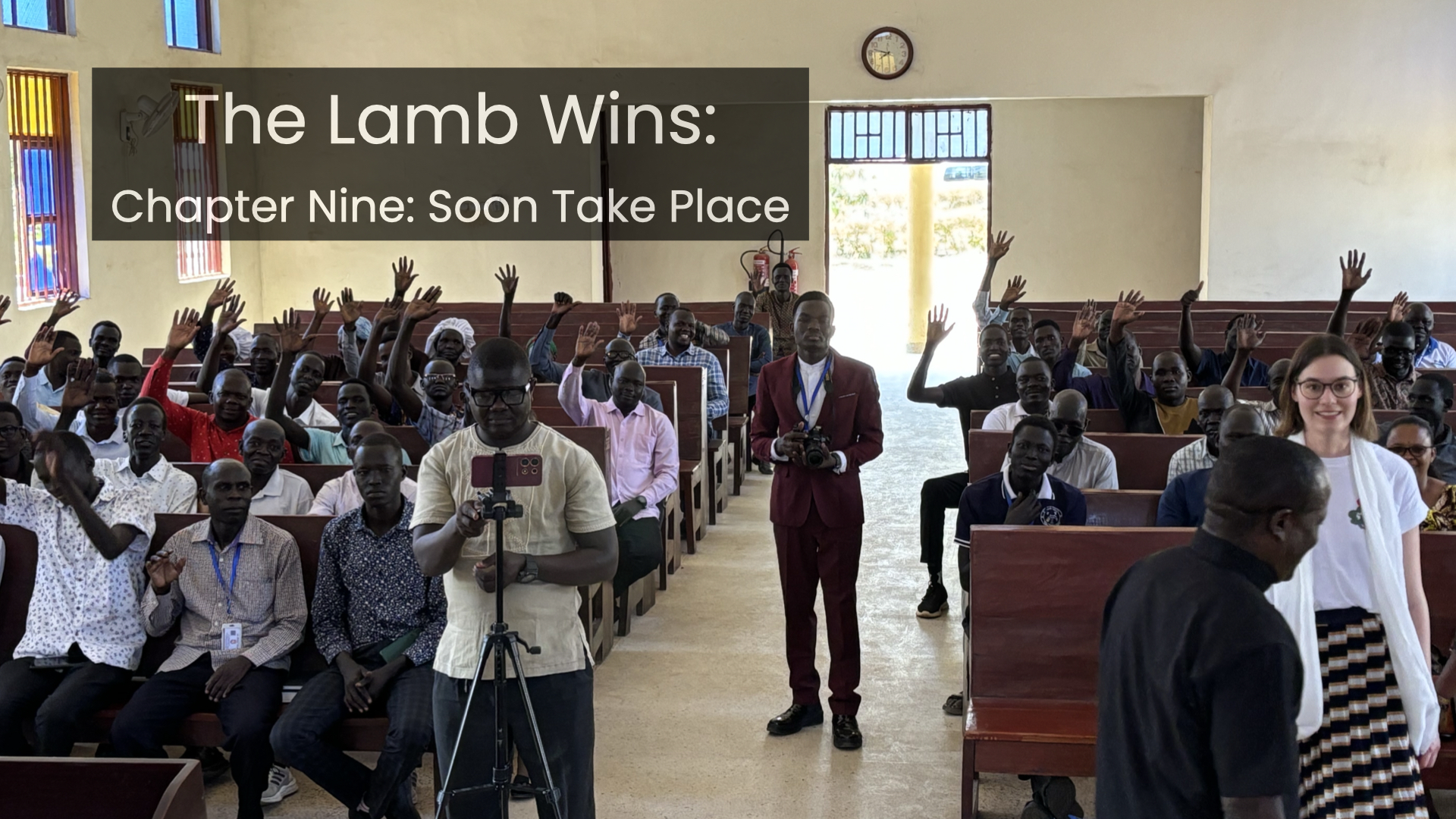
Whether it is at Bishop Gwynne College in Juba, South Sudan, a plucky college beating the political, economic and climate odds to train ministers (and in its expanded role as a University to train lawyers and nation builders in Kingdom ways), or the burgeoning Ugandan seminaries who have asked for SOMA training this summer, or the (largely) half-empty Bible Schools and Theological Colleges of the UK – one of which dramatically imploded last summer – they all have one thing in common. If these colleges or their staff or students are in any way a threat to the kingdom of darkness, they will come under extreme spiritual attack.
The most common of these attacks ends up in spiritual dullness. But there are plenty of others besides – from pride to passivity, from distraction to despondency, as well as temptations to run back to our past or to live in an imagined future, alongside all of the other usual ways the enemy works through our flesh and the world to ‘so easily entangle us’ in sin.
As we continue in Revelation I want to begin to imagine the letter that might be written to our training institutions and seminaries. The reason for focusing here will become clear tomorrow as I tell a story that relates best to Revelation 4 part b. It a story my friend and academic colleague Chloe Lynch says:
‘makes me smile every time I replay it in my memory. I am ‘there’ again, worshipping without reserve, the tears of joy pouring down my face as I gazed upon the Lord and, at the same time, upon this [theological college] community so beloved to me who were encountering God by his Spirit.’
It’s a story that I have seen stir people around the world to prayer, study and mission. A story that took place in a theology college in London just last year.
Colleges are out of vogue at the moment. I have a lot of sympathy with RT Kendall who in his legacy years is preaching a message entitled ‘What they didn’t teach me at seminary, but should have.’ It’s a message about how to lead a soul to Christ, how to not lose an anointing of the Holy Spirit, how to fear God, how to be bold, how to tithe (and preach on tithing) and how to have a heart-level commitment to Jesus.’ He would rather you learnt to pray and read the bible than go to theology college, but if you can watch it and still feel called to study, you’re probably in the right place.
My personal testimony is that God has used each one of my theology degrees to break me, mould me, make me and fill me in ways I could never have imagined being useful at the time. Whether the practical usefulness of studying the formation of the New Testament canon just before the bestselling book Da Vinci Code came out, or the ‘discombobulation of a doctorate,’ my story is that it has all been used by God in his glory. I wouldn’t change a thing.
But I did resonate with this Leonard Ravenhill quote I read this morning:
“The church is preparing for a picnic, but God is preparing us for a war.”
I resonated not least, because when I was at theological college we had a lecturer who thought we should edit out of the Psalter: ‘Blessed be the Lord my rock who trains my hands for war, my fingers for battle,’ [Ps 144:1]. The argument was that it was ‘too violent.’ This despite Matthew 11:12 (where Jesus speaks about the fight needed to take hold of the Kingdom of Heaven which is itself suffering much violence), Ephesians 6:10-18 where Paul talks about the need to have the Armour of God on because of the very real spiritual fight we are in etc…
John Wimber’s famous self-epitaph on his Vineyard movement was:
‘because they were waiting for the Big Bang, the Big Revival, the Big Thing… we’ve made an audience out of them. And they were an army!’1
Leonard Ravenhill predicted that the, ‘The last-day church will be the most distracted church in history.’ He imagined a church drowning in comfort, entertainment, activities, noise, and other blessings, but ‘starve in burden.’ A church that would ‘lose our tears, lose urgency, and lose the agony that births revival. Loud on stage but silent in prayer. Talented in music but poor in repentance.’
He imagined that ‘A shaking is coming. A divine confrontation. A holy interruption.’ A season where God would pull back the curtain and expose everything fake. And that God would walk past the lights, titles, and crowds and choose the hidden ones: the unknown intercessors, burned-out missionaries, prayer warriors with no followers, grandmothers praying in the dark, teenagers who cry at midnight, preachers nobody invites, believers nobody sees.
‘When God can find a man[sic] who will pray, He will shake nations.’
And he predicted a cleansing would come inside the church. A cleansing of motives, pride, pulpits, worship, doctrine, secret sin, spiritual laziness, and diluted gospel messages. Preparing the church by exposing false fire, false holiness, false conversions, false altars, false repentance, false anointing.
Such bold predictions and professorial pontifications are, ironically, exactly why we need theology colleges to train our people. We need to give tools to our ministers and future ministers to weigh up what the Lord is saying. Not to get blown around by every wind and wave of doctrine, or every whisper of revival that might come their way. Not to turn their heads to fantasy, nor apostasy. Not to be a pendulum generation reacting against the past. But a plumbline generation, centred on Christ, gripped by a 20:20 vision of what ‘must take place.’
What must take place is spelt out for us in Revelation 4. This is the heavenly reality that Jesus wants us to fix our eyes on.
Then as I looked, I saw a door standing open in heaven, and the same voice I had heard before spoke to me like a trumpet blast. The voice said, “Come up here, and I will show you what must happen after this.” And instantly I was in the Spirit, and I saw a throne in heaven and someone sitting on it. The one sitting on the throne was as brilliant as gemstones—like jasper and carnelian. And the glow of an emerald circled his throne like a rainbow. Twenty-four thrones surrounded him, and twenty-four elders sat on them. They were all clothed in white and had gold crowns on their heads. From the throne came flashes of lightning and the rumble of thunder. And in front of the throne were seven torches with burning flames. This is the sevenfold Spirit of God. In front of the throne was a shiny sea of glass, sparkling like crystal.
In the center and around the throne were four living beings, each covered with eyes, front and back. The first of these living beings was like a lion; the second was like an ox; the third had a human face; and the fourth was like an eagle in flight. Each of these living beings had six wings, and their wings were covered all over with eyes, inside and out. Day after day and night after night they keep on saying,
“Holy, holy, holy is the Lord God, the Almighty—
the one who always was, who is, and who is still to come.” [Revelation 4: 1-8].
It is in language that will take us a while to understand. A full blown apocalyptic vision, echoing themes from the Old and New Testament. One that makes you glad that some people have devoted their whole lives to studying in original languages, and gaining understanding on the original context, so that we don’t have to go down rabbit holes of our own imaginations in interpreting it.
But at the centre of it is a throne, revealed to John ‘in the Spirit’, where worship continues night and day. The worship announces that the One seated on the throne is Holy, Forever.
Thrice holy.
Ruler. Divine. Almighty.
Everlasting.
This is the picture that Jesus knows churches and institutions under attack need to remember. There is a throne. In the next Chapter we will look at how we are called to respond to it.
If you have enjoyed this post why not pay it forward by sharing the post and maybe take a moment to bless a brilliant charity? SOMA UK relies of the generosity of churches and supporters to fulfil our marvellous ministry – encountering God globally. Every donation goes a long way.
To support our ministry it’s www.somauk.org/donate
Read More in this Series
The Lamb Wins Whole Series Catch Up : Introduction: Chp 1: Hope is Here | Chp 2: First, Love: Ephesus | Chp 3: Fear Not: Smyrna | Chp 4: I Know: Pergamum | Chp 5: Tolerate This: Thyatira | Chp 6: Wake Up: Sardis | Chp 7: Hold On: Philadelphia | Chp 8: Knock, Knock: Laodecia
- Carol Wimber, John Wimber: The Way It Was. N.p.: Independently Published, 1999. 179-181 ↩︎
 Your name is like honey
Thanks very much for this Richard – a great reminder!
LikeLike