
I know your deeds, that you are neither cold nor hot. I wish you were either one or the other! So, because you are lukewarm—neither hot nor cold—I am about to spit you out of my mouth. You say, ‘I am rich; I have acquired wealth and do not need a thing.’ But you do not realize that you are wretched, pitiful, poor, blind and naked. I counsel you to buy from me gold refined in the fire, so you can become rich; and white clothes to wear, so you can cover your shameful nakedness;and salve to put on your eyes, so you can see.
Those whom I love I rebuke and discipline. So be earnest and repent. Here I am! I stand at the door and knock. If anyone hears my voice and opens the door, I will come in and eat with that person, and they with me. [Revelation 3: 14-20].
It’s that ‘cook up a Christmas sermon’ time of year, and I’m trying to work out what to say next weekend!
At carol services up and down the land there must be more than a few vicars tempted to quote from the words written to the Laodiceans in Revelation 3. Leaving the comfort of the crib for a more ‘in yer face’ message a few might try to make ‘I stand at the door and knock’ v.20, not sound like a bad Christmas cracker ‘knock, knock’ joke to their midnight communion crowd, who may have just tipped out of the pub.
Others will stray into politics, taking a seasonal moment to reinforce social consciences and consciousness, urging ‘spiritual eye salve’ to see the plight of the world, and suggesting – subtly or not – that a collection might help cover our collective ‘shame’.
Literary ones, or those who have watched too many Hallmark Christmas movies, will no doubt find an Ebenezer Scrooge antecedent in v.17 where the misguided protagonist has ‘acquired wealth and does not need a thing’, but is missing the point of Christmas according to the film – sharing kindness with any Tiny Tim replica you can do some good for, (and probably tinsel, family and true love as well).
Dear Anglican friends, the Christmas silly season is upon us.
All too often we’re offering messages that if we’re honest wouldn’t have converted us either, as we’re not quite sure whether to woo or warn our Christmas congregations. Whether to blow hot or cold. Whether to leave it all out there on the field, or leave a tantalising titbit we hope will draw them in.
We find ourselves hidden behind props of choirs and candles, enormous orange shaped suits that may have as much relevance to the Christmas story as the ‘first lobster’ did in the nativity scene in the film Love Actually, mulled wine and mince pie refreshment stands on our outdoor carol service, or behind cute reenactments of idyllic birth scenes in a stable with a rented donkey or camel making a cameo appearance to the packed crowd. All these are fun and often wonderful parts of Christmas that bring the neighbourhood together. But…
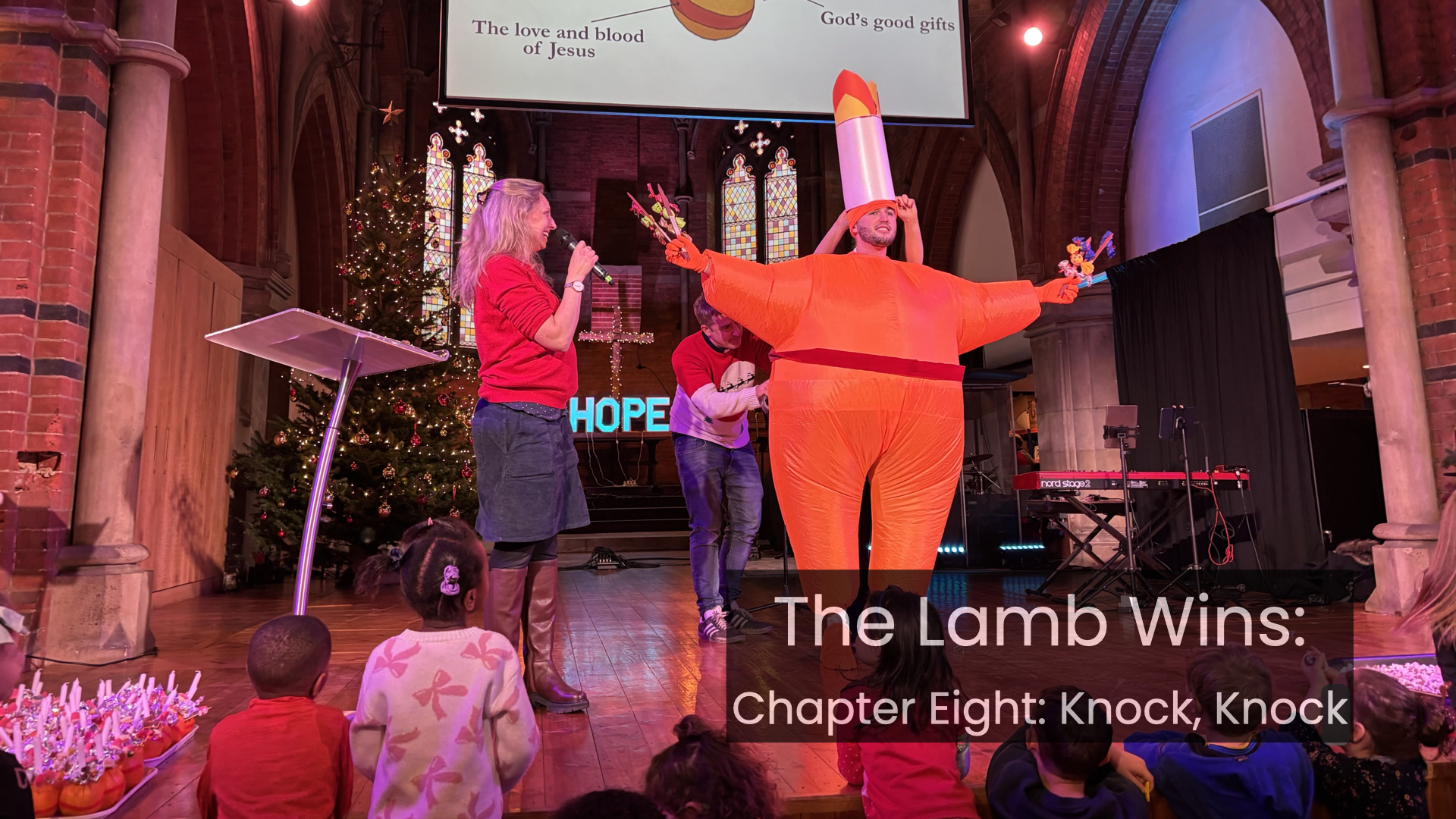
…What happens when you do a spiritual audit on your own heart at the end of the Christmas season? Maybe it’s an Epiphany epiphany. Maybe it’s a New Years Resolution. Maybe it’s a Boxing Day crash that began with ‘Clergy Malt Club’ as you shared in a dram (or three) with clerical colleagues on Facebook, Insta or Twitter at 01:00 on Christmas morning… but didn’t stop and didn’t recover until the New Year.
The ‘knock, knock’ in this passage is aimed at the Church, not those outside it, and it’s not a joke.
It’s the church that Jesus, the ‘faithful witness’ has his attention on in Laodicea. It’s not the seekers or Christmas carollers. And, as with the other 7 letters, it is the ‘angel of the church’ that he calls to account and writes to. Who/what is that angel? We’ve skipped over that in the past 6 letters, but the angel may represent either the human leader or the overall spiritual health of the church (or both as they are definitely interrelated).
I wonder how it might affect the rest of our December if we made our own spiritual health as leaders and churches a priority? Put it another way, at what point in the calendar year did your last prayer meeting happen? I wonder how it might impact those carollers if they could see deep in us something spiritually invigorating? If they looked and saw us to be hot like a spring in a sauna, or cool like fresh mountain water?
Would that version of you/your church be enough to convert your younger self?
The Laodiceans sadly failed their divine audit, even after their self-assessment came out fine. Their impression was that they had riches and wealth and did not need a thing. The Lord saw them as 1) wretched, 2) pitiful, 3) poor, 4) blind and 5) naked. His remedies for five maladies were 1) refined gold, 2) righteous clothes, 3) eye salve.
Curiously, unlike the gifts of magi, these are gifts the church needs to ‘buy.’ We’re used to God’s riches and kindness being a free gift (grace), so why the purchasing here? What price is needed for refined gold, fine fresh clothes and eye salve?
Jesus is echoing Isaiah 55:1:
“Come, buy wine and milk without money and without cost.”
In Isaiah, “buying” means actively turning to God to receive what He freely offers. It requires desire, humility, and surrender — but not money.
So the grace is free. But receiving grace requires letting go of what makes you self-sufficient.
The Laodiceans’ problem was not lack of wealth — but self-reliance. They said, ‘I am rich… I need nothing.’ This free grace is going to cost them everything they rely on, or they’ll be like the monkey who can’t get his clenched hands back out of the cookie jar.
We too have to pay the price. Not with money, (although it is true that our pockets can be the last part of us to be converted and they need converting), but the price in mind here is repentance, surrender, and dependence on Christ instead of ourselves.
- letting go of false security in what we own, and can do.
- admitting our spiritual poverty.
- letting Jesus expose and correct us.
- opening the door of our hearts to Him (Rev 3:20).
Of course sometimes that will mean a radical generosity. It’s hard to know what you are holding on to as security until the Lord challenges you to give it up.
Jesus’ famous ‘Sermon on the Mount’ taught that, ‘you cannot serve both God and money’ [Mt 6], and that it was those who ‘hungered and thirsted after righteousness’ who would be filled. [Mt 5]. Being clothed in righteousness is unlikely to cost spiritually less. He also taught that our ‘eyes are the lamp of the body’ and if they get unhealthy ‘your whole body will be unhealthy too.’ [Mt 6]. These are the words we are supposed to build our life on. [Mt 7]. Following Jesus is free, but it may cost you everything.
Dear Anglican friends,
Let us pray…
… and take a moment to ‘lean back in the loving arms of a beautiful father’.
We’re better when we pause. And there’s gold, fine clothes and eye-salve to add to our spiritual shopping list. Why not listen to this now (Lean Back, Capital City Music). And, as you do so, can hear your loving Father knock on the door of your life? Let him in!
If you have enjoyed this post why not pay it forward by sharing it and by blessing a brilliant charity? We rely of the generosity of churches and supporters to fulfil our marvellous ministry – encountering God globally. Every donation goes a long way.
To support our ministry it’s www.somauk.org/donate
Read More in this Series
The Lamb Wins Whole Series Catch Up : Introduction: Chp 1: Hope is Here | Chp 2: First, Love: Ephesus | Chp 3: Fear Not: Smyrna | Chp 4: I Know: Pergamum | Chp 5: Tolerate This: Thyatira | Chp 6: Wake Up: Sardis | Chp 7: Hold On: Philadelphia.
 Your name is like honey