Sitting in the team room at General Synod listening as a chaplain to delegates I wonder what are the good questions to be asking today?
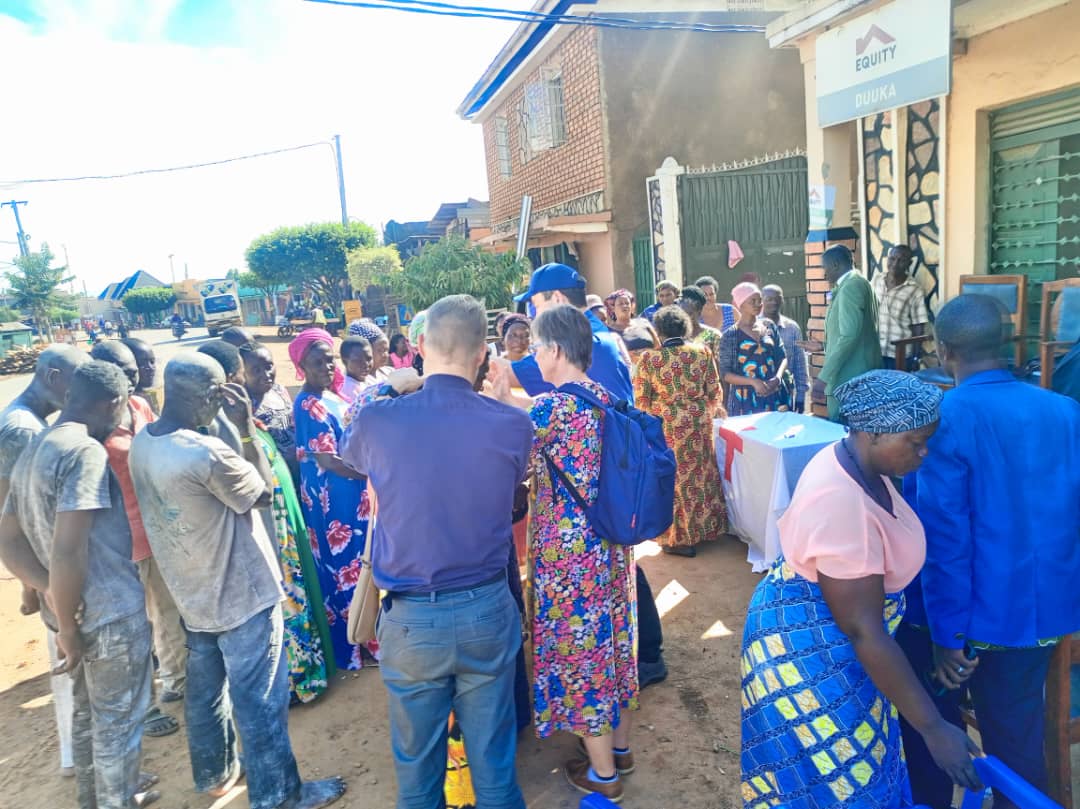
We currently have a SOMA team out in South Rwenzori, Uganda where the bishop has brought together 3000 preachers to reach 1 million people in 8 days! Here’s an extract from the first day report from my friend and colleague Henry Blair:
After lunch we divided the team and two of us went to the radio station where James (Ugandan team member) introduced the mission and I then got to preach from psalm 23. The station is called Messiah Radio and reaches 2 million people in the area. The other half of the team started doing an open air service and then we joined them for the prayer ministry at the end. Wayne shared the first sermon, then a local lady shared testimony and then Joshua (Kenyan team member) preached on healing and James gave the altar call and 21 people committed their lives to Christ and most people came for prayer ministry.
SOMA UK Mission to South Rwenzori, November 2023
I mention this because of the stark contrast between this and what is going on in London, and I wonder how many people are even aware that Global Anglicanism really is a wonderful missionary movement? How many olive branches of hope could be brought back to these shores if in ‘our dotage’ (to quote a Synod phrase from yesterday) we paused to watch what God is doing in churches that have come of age and are leading the way in church planting, prayer and pursuing God.
A full day of that mission will be spent on a prayer mountain seeking God. Each morning begins with a rousing intercessory prayer service… there is so much to learn, so much to return to.
Are we entering our ‘dotage’?
If they represent a church come of age, what of us in the ‘mother Church of England?’ Are we indeed ‘in our dotage’ as a national church, hovering in and out of forgetfulness (‘is it a doctrine, dear?’), and sometimes flashing in and out of bursts of anger and manipulation to get our own way (‘I don’t feel like you love me, listen to me, want me, visit me etc’)? Are we fermentingfear (‘what will the King/parliament/press/ public say to me if I swim against a cultural tide)? Are we behaving like the culture may be going to hell in a handcart, but at least we get to be part of the handcart and it’s a bejewelled handcart at that – like the coronation carriage with nice ornamentation to enjoy on the journey even if the suspension is bust)?
Mike Tufnell speaks to the Synod
What if there is not a middle way?
Anglicans (in England at least) have been taught to think that the answer is always in the middle. It’s plain inconvenient (as Andrew Goddard has argued )that there is an issue here where there are several certainties that simply don’t coexist together. Although it is often described as ‘a season of uncertainty’ is it an uncertainty of our making, or is it a process that has exposed that the Church of England umbrellas not just different ‘parties’ but entirely different religious systems? One group believing they should affirm ‘any sexual practice between two consenting adults’ (as a prominent campaigner suggested at the end of Question Time yesterday) and another who believe that the church’s teaching has always been self-denying, not just in issues of human sexuality but as a core christian concept. They point to our baptismal calling to trust Christ as Lord, to turn away from sin, to reject evil and to turn to Christ as Saviour and to Jesus’ high bar of discipleship where he discourages people from following him unless they are willing to take up a cross. They say this is not about ‘affirming us just the way we are’ but ‘loving us while we were God’s enemies, and loving us enough not to leave us as we were’. One group is compelled to change doctrine (either openly or surreptitiously), another is compelled to resist. What
What should you do in a season of uncertainty?
The offer on the table is what almost no-one wants apart from a) an interesting group who basically want to say ‘I don’t want anything substantive to change but I am prepared to confirm a confusing compromise’, and b) those who simply see it as a crack in the dam which will allow a deluge to come through in the future so any step ‘forward’ is better than none). I don’t think anyone in the room is uncertain about any of this. After all if it was a genuine time of uncertainty you’d probably do what hikers do in the wilderness when they have lost their way – retrace your footsteps to the last time you were on a solid path, find the ancient ways and walk in it.
What have the Scriptures been saying while we have been here?
It is always worth paying attention to the collects and bible readings set for the Synod days.
The opening line of Tuesday’s psalm in morning prayer is ‘let me not be put to confusion’. The gospel reading included Jesus saying “whoever will break one of the least of these commandments and teaches others to do so the same will be the least in the Kingdom of heaven”, and his warning not lose our salty savour as he reminds us that and that he has not come to destroy the law or the prophets. The Monday morning prayer had a reading from Isaiah pronouncing woe on they who draw iniquity with a cord of vanity, and sin as if it were a cart rope; and woe unto them that call evil good and good evil. Could it be that this is aglorious anticipation of the Orwellian doublespeak that can prevail in synod speak where words can be allowed to mean absolutely anything you like at all?
What do friends outside our cultural moment say?
It’s always instructive to talk to Synod observers about what they are hearing. I had a few minutes with a senior visitor from the Global South who was new to Synod. He could barely believe his ears: “They’re bishops?” he stated incredulously. “They’re really bishops saying those things about the bible, they’re really bishops talking that way?”
‘Did God really say…’
It’s going to be an interesting second day at Synod. One of the dividing lines will be about whether delegates believe God has really spoken in Scripture. One of the common comments is that ‘there are different ways of reading Scripture in the room’. It may be worth delegates reflecting on where the phrase ‘Did God really say?’ is introduced in the Scriptures, and in both our questioning and pastoral provisions do we want to stray into echoing the words of the serpent in the garden of eden when we make decisions about what we think holiness actually may be?
What could we do if we were not here?
I imagine there are many delegates on synod who would happily join Helen, Henry and the others on a mission preaching to a million people in 8 days, but who feel that they have to be here instead to ‘row the boat backwards (or forwards) up (or down) the cultural river’. As one questioner said yesterday, ‘how much money and energy is going into these sessions alone? How much energy is also being diffused in parishes, mission agencies and other settings in what has enormous potential to become an (un)civil war masked mostly behind nice enough Anglican faces. What would it look like to commission 3000 missioners to go out around one of our Anglican Dioceses in the CoE? To invite the Global church to share the life changing message of Christ in our parishes? To call out to our lively, faith-filled friends and say, ‘you’ve come of age, help us in our dotage?’
If we could disentangle ourselves from these disputes, operate the Gamaliel principle, and walk apart for a while, might we like Jacob have our Bethel moments, and like Esau find our anger abetting, until two siblings can eventually be reconciled to each other through the benefits of maintaining a certain distance?
Is it time to recognise that there are good reasons in God’s purposes with biblical precedents for a family called by God to walk apart, trusting in his Sovereign hand, and learn from church history and other Provinces to ensure we find the least painful way to do so?
Another excellent piece, thanks Richard. It does amaze me that the church evangelical conservatives are so concerned about marriage when in the last decade many have done very little to practically support marriage in our nation. The average church now has two weddings and the influence of the Church of England re marriage is declining rapidly. Even with this deteriorating situation the church still wants to charge, even the poorest couples, fees starting at over £500.



 Your name is like honey
Another excellent piece, thanks Richard. It does amaze me that the church evangelical conservatives are so concerned about marriage when in the last decade many have done very little to practically support marriage in our nation. The average church now has two weddings and the influence of the Church of England re marriage is declining rapidly. Even with this deteriorating situation the church still wants to charge, even the poorest couples, fees starting at over £500.
LikeLike