
I know Graham a bit from the 2000s where we overlapped as ministers in Wolverhampton. I was delighted when I came across his doctorate research into spiritual warfare and that it was available in book format. The intellectual gradient he is trying to walk up in the book is well outlined by a former Bishop of Chester, Peter Foster, reviewing the book in the Church Times (22 June, 2018):
Its main energy is in the theological discussion of the nature of evil, and of the devil (and associated demons). This circles around two linked issues: is the devil to be regarded as a personal figure, and, if so, where did he come from?
There is a sharp division over the origin of the devil. Is he a “fallen” angel, who abused his freedom much as Adam and Eve are portrayed as having done? This was the predominant belief in Judaic thought at the time of Jesus, and it makes a minor appearance in the New Testament itself, although mainly by allusion.
In the patristic period, and until after the Reformation, this was the main explanation in the Christian tradition of the origin of evil. More recently, Karl Barth leading, this has been disputed: how could an angel, created as part of God’s good creation, become evil?
Some writers, such as Walter Wink and Amos Yong, have accepted Barth’s critique, but have tried to explain why evil nevertheless manifests itself in such vivid and quasi-personal ways. Evil is best seen as a godless emptiness that has complex ways of taking form in the experience of societies and individuals.
Smith ultimately opts for the view of the devil, and his associated demons, as fallen angels. The essential nature of evil as rebellion is particularly persuasive for him.
But Bishop Peter Foster remains unconvinced.
(It is striking to me that in the West, Karl Barth’s worldview seems to have eclipsed Jesus’, leaving evil as a mere absence of good, rather than the personal malevolent force Jesus encountered in Gethsemane and the desert, and through a myriad of evil and unclean spirits who were agitated against him. Karl Barth, notoriously blinded by sin in his maintenance of a long-term three-way relationship with his wife and his colleague Charlotte von Kirschbaum, remains a theological stronghold over the Church in the West, and is it possible that his blindnesses in this and other matters have been allowed to deilluminate hundreds of thousands of souls? If you’re happy to entangle yourself in sin, why would the devil need to show up to help?)
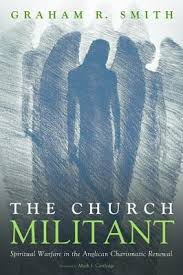
Smith’s book is helpful as an insider-researcher, drawing from personal experience in charismatic renewal, and doctoral-level research. It brings prophetic edge and scholarly substance to a topic most avoid: the spiritual battle at the heart of Christian mission.
Rooted in the historic formularies of the Church of England and shaped by Scripture and liturgical tradition, Smith calls us back to an understanding of the Church as the Body of Christ at war—not with flesh and blood, but with the spiritual forces of darkness. His ecclesiology is not just academic—it’s missional. He invites us to rediscover the spiritual realism of the Book of Common Prayer, where we pray to be delivered “from the crafts and assaults of the devil,” and challenges a theology that has domesticated both evil and the Church’s vocation to overcome it.
Smith doesn’t just theorise about spiritual warfare—he diagnoses the practical implications of its neglect in local Anglican contexts. He critiques the way in which rationalism and institutional caution have often squeezed out space for deliverance, healing, and bold intercession, replacing them with managerialism and mild niceness.
Graham’s tone is hopeful, and he has a restorative vision, whereby churches can be re-formed as training grounds for holiness and mission, equipped for intercession, discernment, and gospel confrontation—not in aggression, but in the Spirit’s authority. His chapters on spiritual formation, corporate prayer, and the theology of conflict are especially useful for ordinands, mission leaders, and PCCs alike, and he challenges the charismatic movement to grow deeper in theological maturity and ecclesial rootedness. It’s the kind of book that could be read in theological colleges, discussed in diocesan renewal groups, and prayed through in clergy chapters.
So a helpful book, urging that the Church has a real enemy to combat, and it is not called to survival, but to advance. This book might help the Church of England remember how to do all that, but I suspect, only if some intellectual strongholds that have taken root get demolished first!
 Your name is like honey