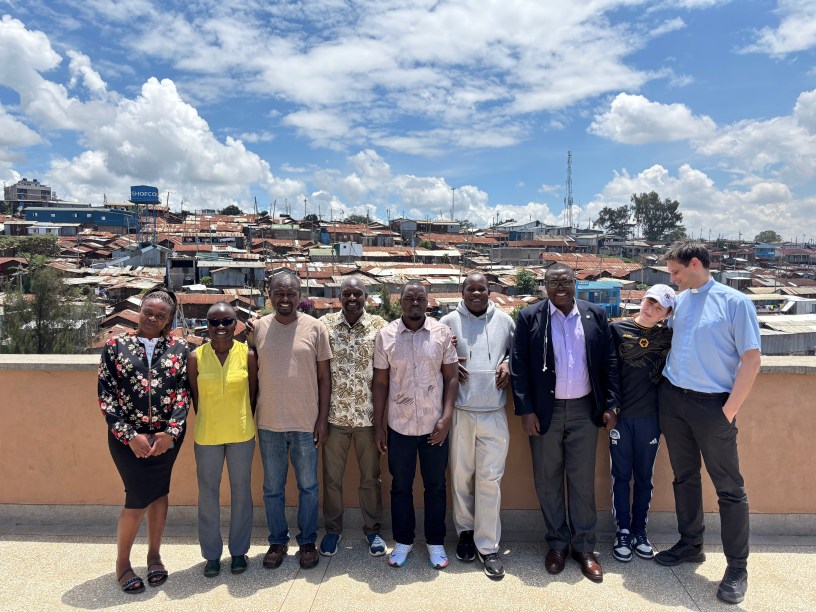
It’s now nearly a week after we left Nairobi and I am writing this from Diani Beach, just south of Mombasa, not far from Tanzania on the East Kenyan shoreline. The hotel is nearly empty as this is the off-season (goodness knows why – it’s 30 degrees, well equipped, white sands, attentive staff – some of whom I spotted praying together as a group before they started serving guests – and action packed with things to do). The guidebooks all tell you it’s the rainy season, but that means different things to a Brit who has endured a November, February or March in Skegness or Minehead than it means here. When we’ve had rain it’s been at night time, refreshingly cooling and it makes the country stunningly green and beautiful. And we have not seen a drop of daytime rain for 5 days now.
Those who are here are mainly from Nairobi, plus a few ex-pat Kenyans returning to Africa with loved ones. The locals have a special name for these internal tourists and they’re the ones who have kept the hotels going since Covid. There are different ways to do a holiday in the Mombasa region, and a wide variety of price tags. Entry to National Parks is 1/8th of the price if you are a national but the wealth range in Nairobi is extreme and so while some may take the crowded bus for 10+ hours, others can board the train, and still others hop on a 45 minute flight to get here.
Nairobi as we experienced it was certainly a tale of two (or more) cities. Our itinerary began with a boarding school where bright 14-18 year old boys pondered their future as nation builders and professionals as they geared up for the transition to studying for the first of the degrees they would likely attain. In between visits we made our first of three stops at the Kibere slum as reported here. Over the next 5 days we continued to see the contrast. Thursday was a striking day with Archdeacon Gilbert, who took us to a Westfield style shopping mall, then navigated around a high-rise community where he has done a church plant, on the way to speaking at a healing service at his church in Nairobi Diocese close to the airport. The high-rise was what the government are slowly trying to transform Kibere into, 10-12 stories high, right onto the road, which is reduced to a single lane in width in many places as street sellers set up their wares on either side. A mass of humanity throngs the road, making progress in a car limited to 1-3 miles per hour. The flats above the road are more spacious than the corrugated dwellings they replaced could ever be, but the desire to be at ground level, out and about in community, prevails as kids play with tyres in the roads amidst the noisy bustle of a thousand voices selling wares turning the throughfare into a pedestrian zone cares are mildly tolerated in.
In All Saints Diocese I get to speak at a church plant designed for workers in the high-end businesses near the ACK Guest House. Like the boys at boarding school these are people going places. It’s a high aspiration professional environment with the service starting on time and lasting just 45 minutes to fit lunch hour commitments. In the evening Toby and I attended the monthly healing service at All Saints Cathedral, a church with 5000 attendees, 10 services, a cappuccino serving cafe and rooms for rent including one that had been used as a high end members only gym. I speak at the service, which is in some ways a contrast to the one I return to the Cathedral for in the morning, and in other ways a cultural continuation. This one is band led, with passionate praying, stirring speeches and contemporary in feel with some lay leadership. The daily 7am Holy Communion is liturgical (there is a Kenyan version of the Book of Common Prayer which is an impressive update), uses old hymns, is much smaller, based in the side chapel and has an older congregation. But the communion is led with sensitivity to the Spirit, the sermon includes a moving testimony of a mother (the clergyperson preaching) whose child had been badly burnt while she was away on a mission, and how she has chosen to trust God through all the ups and downs of the past year of parenting. Both services attract educated people, both open to moves of God, both in English (a favoured medium here among those whose schooling has been in English). Both services encouraged me deeply. In fact, in a move that parallels some of our job adverts in the CoE imploring candidates from a UKME [UK Minority Ethnic] or GMH [Global Majority Heritage] background to apply, the Cathedral are looking for an outside missioner to join them – focused on reaching the white community in Nairobi. A tempting post for someone I would have thought.
But it is the Kibere slums that stole my heart. We took Toby to visit a project called the Urban Centre for Mission, that for me just seemed fantastic. It helped that my friend and mission partner from our South Sudan Feb 2025 SOMA mission was there with me, as I knew he had grown up within a stone’s throw of the centre, and had ministered a hundred yards away at St Jerome’s. Two of our other guides had also been through this project, enabling them to complete an education against the odds.
Essentially the school system as explained to me is that there are private schools, state schools and then a level of schooling that might best be described as charity or local schools. Many others attend state days schools. But the ‘local schools’ are much more makeshift. 40% of children attend boarding schools – some I spoke to had been hurt by this system and wanted it to change, others thought kids got a better deal there as parents here are industrious, out to work early and back late, and the pupils would be left to their own devices for hours if not at school. The local/charity schools meet in halls or churches, and the Anglican Church of Kenya has many such schools, where the clergy double up just as not as priest + chair of governors but as priest + headteacher, bursar, caretaker and much more besides, while they continue to run the church for the community. After primary school hours the church gets turned into a homework club for pupils who have gradated on to high school to come together and study in the only place where there will be light, space and encouragement to do so.
With more than 2 million people in this slum the experience of visiting is a lot to take in. The school at St Jerome’s is an absolute joy, as class after class welcomed us with a different greeting song – most of them a simple chorus. I’m still trying to work out how Toby, my 13 year old son who is travelling with me, experienced the visit. My guess is that the culture gap for him would not be so different to that for one of the Kenyan teenagers we saw at the shopping mall or boarding schools if they visited. I noticed that those who lived/worked in Kibere at the Centre for Urban Ministry experienced Kibere as a very safe place to be (they are known and appreciated and protected). Those who rarely visit were much more cautious and aware of the potential for gangs and crime: ‘I have learnt to dress down when I visit’, ‘or dog collars definitely saved us there.’
But back to the Urban Centre for Mission. It’s a project that inspires. It could do with an injection of capital to complete the furnishing of it’s workrooms: a recording studio, science lab, IT room, training room for urban ministers, sewing room for making school uniforms, and some clinicians who could realise the dream of providing health-care at the ground floor. The gym has some basic equipment and anyone in the community can lift weights there, and it’s popular with men and women. It’s a space for the chaplains to reach out to gang members too, as they love to come and work out. The studio is a clever dream: to enable local people to tell their story their own way, ‘lots of people talk about us, but we have a story to tell no-one seems to quite understand.’ The science lab (7m x 7m) will be used by four local schools on rotation. And at the heart of it all is an ‘Air BnB’ room designed for scholars or minister’s on retreats where you can spend a night, week or a month living one storey up in Kibere, behind the Centre’s safety gates, and get a close up view of what it’s like to be incarnational in an extreme urban setting. Less than 50 years ago this place was a forested river valley complete with jackals and foraging animals. The human impact on the landscape is immense.
We left Nairobi so grateful for all our experiences and looking forward to returning. The Anglican Church there spans the two dioceses – Nairobi and All Saints Cathedral Diocese – and we were warmly welcomed in each. There is much for UK teams to learn from here, and not a little partnership that could/should be possible.
 Your name is like honey