
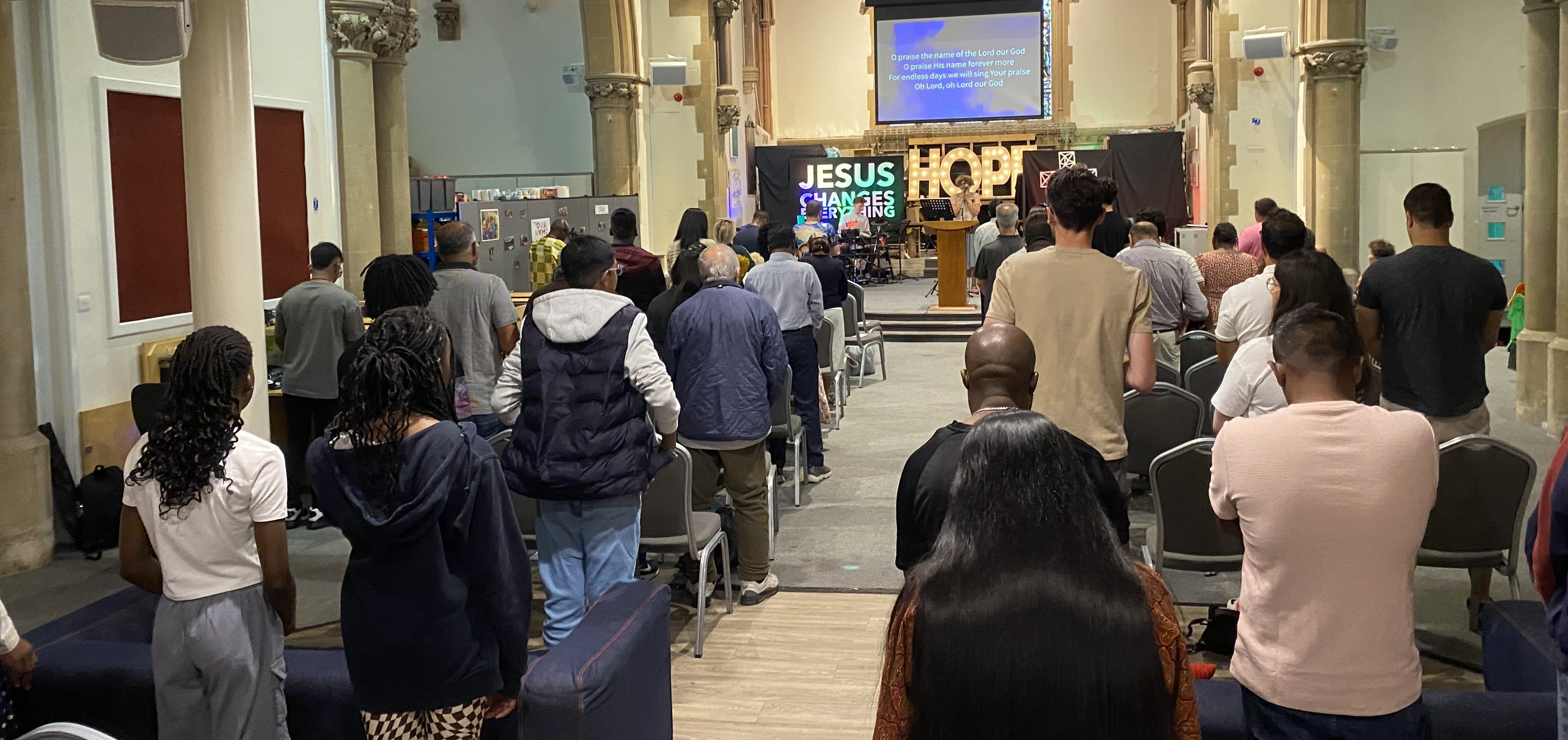
It was an absolute joy to speak at the multicultural, community serving, faith enhancing church that is Hope Church Hounslow today. I was there the night Libby Etherington was licensed in 2012 and visited her successor Claire Clarke and team in action mid-week and delighted that Claire has been organising a SOMA team for India and been a huge encouragement on our National Leadership Team. But it was first Sunday visit and it was a delight to preach.
The topic given was speaking truth to power, part of their series on the life of David.
As I got up to speak I felt compelled to say:
“The punchline of this message is that: It is not OK if you sin, and it is not ok to God when others have sinned against you.”
At the end I had loads of men come up to say, ‘you know we often hear the bit of the story where David is forgiven, and are encouraged that we can be forgiven too. We don’t often hear in churches that there are consequences for our sin… thank you for sharing that, so powerful’.
To be honest, I was preaching at me. Compelled by the passage to pray something like:
“Lord, don’t ever let me get comfortable in sin, or repent/forgiveness cycles… stop me from hurting myself or others by defining my life by the way I feel… make me obedient to the Lord Jesus Christ and deliver me from the evil one…”
Maybe you’d like to read along and see what you think? “Jesus Changes Everything” says the sign at Hope Church Hounslow… perhaps we’ll realise he can change you (and me) too?
Text below:
—————————————–
2 Samuel 12: David confronted by the Prophet Nathan
I always think parents are a bit brave if they call their son Nathan. It means a gift of God, but in this case the gift is ‘truth telling.’ There aren’t many people who ‘can handle the truth’. It flies against our better judgment of ourselves. It exposes the bits of us we like to be hidden. Generally ‘we can’t handle the truth’ about ourselves or others. As we look at this passage we’ll see that calling your son after this prophet would be a bit like calling your son after ‘John the Baptist’ – but at least then most people would assume it’s the nice John who wrote that positive gospel and love filled letters that you were thinking of. Not many people like having to challenge Kings.
John the Baptist’s nemesis was King Herod, and he got his head served to him on a platter for ‘oversharing’ that Herod was an adulterer.
Nathan’s nemisis in many ways was tougher. Someone he admired. A friend. A national hero. King David.
It’s one thing to speak truth to unpopular power. Quite another thing to look someone in the eye who you have affection for and call them out on their idolatry, adultery and wicked murder.
Nathan does all that.
His hero King David had taken a break from his mid-life responsibilities. Instead of being defined as the servant of the King of Kings – the very task prophet Samuel had annointed him for, instead of being defined as the King of Israel and commander of his nations defenses, and instead of going to war as this servant of Israel should have done, David has got it all wrong.
He self-identifies as a regular King of any old nation. A King of his own life with no-one to answer to.
Based on his feelings and power he self-identifies as a man who can do whatever he wants to feel good.
What does he want? Sexual gratificaiton.
When does he want it? Now
Who does he want it with? The woman he’s been lusting after from his rooftop.
What does he do? He takes her
What does that lead to? Pregnancy, the death of a baby and a horrific cover up.
All because he self-identifies as a man who can do whatever he wants, he self-identifies as a man who can let his feelings define him, he self-identifies as a man who doesn’t need to hold back on his lusts, because he self-identifies as a man who can grab what he wants when he wants no matter what the cost.
All because he forgets God is supposed to define his life. He’s supposed to be ‘God-identified’ as a King responsible to a Great Shepherd. He is supposed to be God-identified as someone who can fight and to pray. He is supposed to be God identified as someone who can lead and to serve. God-identified as someone who will put God first and nation second, and God identified as someone who will not define themselves in any other way that diminsihes that high calling.
To be someone who will not listen to that little lying voice that whispers in his and our ears teh insiduous words ‘did God really say…?’
“Yes” the answer to that question is almost always “Yes, God really did say, so stand back from your self-defining stupidity and remember you are supposed to be his, not your own.”
So Nathan has to confront his hero, a man with the power to put him to death on the spot and cover it up. After all he’s just done that to one of his best mates, after stealing his fighting friend’s wife.
Do you ever have to stand up to power. Who do you have to stand up to?
In the Church of England at the moment we see many people realising that they need to confront the powers that be. I was at a meeting in the autumn where a senior charismatic evangelical Anglican was saying he would need to confront a powerful friend to his face and even take him to court if needs be. Like Nathan and David they had been long term friends. It is not easy to stand up to power. On a similar theme several bishopa I respect have co-written a public letter confronting other bishops who have been listening to the ‘did God really say?’ process and ending up in a God-awful muddle. Thank God for those who can and do stand up to power.
We live in a world where the culture tells us we should define ourselves by how we feel. But we worship a saviour who says we should build our lives on a rock which is a firm foundation. What is that rock that wise people can build their house upon? What is the rock that can withstand winds and waves? Is it his love (as the song goes?). No. Is it his grace/kindness? No. Is it his mercy? No. What is the rock wise people build their house on according to Jesus himself? It is his words – the words specifically that feature in the Sermon on the Mount (Matthew 5-7) where he tells that foolish and wise builder story.
Nathan uses God’s words to show David he has been building on sand:
Firstly in v 1-4 he tells a story. Very much like Jesus does he tells a simple parable of how a strong man has robbed a poor man. David reacts to these divinely given words. He ”burns with anger” against the strong man, pronounces that he must die and orders that his estate pays back 4 times as much to the poor man (v5-6)
But its a gotcha moment as Nathan shows David that his reaction while just is misplaced. His just anger against sin is righteous, but the object of his anger is wrong. It is not a fictional strong man who has done the wrong, it is King David himself.
Secondly then Nathan uses God’s words directly and not at all subtely to teach the King directly (v7-12 and 13-14). God’s words back David into a corner, pierce his heart and pronounce punishement for and consequences of his actions.
The consequences are enormous. What David had done in secret would be done to him by a family member in public and the child born to him would die. (That’s all on top of the guilt of realising he’s committed adultery, is directly culpable for the murder of Uriah, and that he has caused other fighting men to die in the mess he’s made too).
Suddenly David is hauled back into divine reality: he is not self-identifying by his feelings, but seeing himself through God’s lens. What does he see? v.13 He sees that he has sinned against the Lord. He hears Nathan pronounce judgment and punishment and ultimately repents in deep and meaningful words recorded for us in Psalm 51. There he pours out his heart to the Lord and begs to be defined by God’s perspective not his own… no longer is it “God let me do what I feel like doing’ No longer is he saying> My feelings are my God and I must obey them to be fulfilled… now he’s saying to God search me and see if there is any sinful ways in me – create in me a clean heart… grant me a willing Spirit to sustain me…’
In other words the mighty King David, through God’s judgement and words comes to want to build his life upon God’s teaching again, knowing that he needs the Holy Spirit to empower that in him.
Ultimately it is a semi-happy story.
- Nathan is not beheaded, but heeded.
- David does not persist in sin, but repents.
But a child dies, a man is still dead and the consequences of David’s sexual sin impact at least three more of his sons directly who from then on are some messed up cookies in the sexuality department. The ‘public humilation’ promised by God came to pass when his son Absalom sleeps with/rapes all David’s concubines on the roof of his palace; another son of his, Abner, rapes his own half-sister and a third son Adonijah, asks to bed the girl Abishag who David has in his bed to keep him warm in his old age. And that’s before we clock the impact on Solomon (second child of David and Bathsheba but whose whole reign is also undermined by following his father in accumulating wives who are bad for his spiritual health). It’s a mess of soap opera proportions, largely owing to the fact that David looses all ability to speak into his family story after this callamitous cock-up.
Thank God Nathan confronted David and he could be restored.
But look at the devestation building your life upon the sand of your feelings can reak on a life.
Friends, let’s step back from those who say that we can self-identify in any way we feel like and see that foolishness for what it is – a recipe for death and detruction. When Jesus said ‘teach them to obey everything I have commanded you’ he didn’t say ‘if it feels right’. He didn’t say I have come so you can do what you feel and become a slave to those feelings. He just said obey (no matter what it feels like).
In a world being built on quicksand, be a Nathan not a David. Don’t think of yourself as “God’s gift” – a hero who can do what they feel like, but be a real ‘Gift of God’. Do the hard things, based on God’s word, obedient to Christ. And find the right way to tell others the truth too as one ‘sinner saved by grace’, to another.
“ALMIGHTY God, unto whom all hearts be open, all desires known, and from whom no secrets are hid: Cleanse the thoughts of our hearts by the inspiration of thy Holy Spirit, that we may perfectly love thee, and worthily magnify thy holy Name; through Christ our Lord. Amen.” Collect for Purity, BCP
 Your name is like honey
BRILLIANT.. thankyou.. not sure what it is re answering on the site.. I can never get on.. ? .. no worries.. excellent sharing..x
LikeLike
Thank you.
Reminds me how much the life of Jesus is one of speaking truth to power as well. Hard to do, but perhaps this is why Jesus teaches so much on the day of judgment / day of his return. Lose sight of that and many mistakes follow.
/
Please keep blogging these messages 🙂 they need to be heard
LikeLike
great preach brother!
LikeLike