What happens when two brothers have deceived, tricked and let down their parents so much that they cannot stay under one roof? In the book of Genesis mother Rebekah sends one of her sons off into the wilderness, thus protecting both the deceiver and the impetuous son. They both still bear the family name: ‘Ben Isaac, Ben Abraham’. When they finally come back together they somehow avoid killing each other, despite a bit of a face-off. Along the way they each mature, flourish, reflect, repent and wrestle.
I wonder if some wilderness wanderings would do us all some good – especially if we want a chance at staying as one Anglican family in the end… Ben Cranmer, Ben Augustine et al…
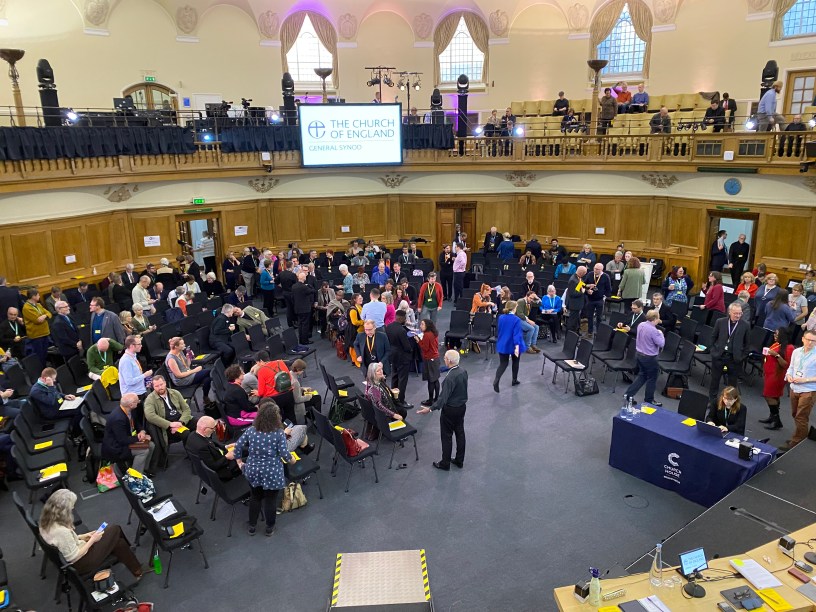
Here at General Synod it’s day three. The voting statistics in synod so far suggest a level of division that a parish priest would gulp at before pushing through a motion at their PCC. Nevertheless the front bench of the Archbishop of Canterbury, Archbishop of York, the Bishop of London and the Bishop of Winchester are determined to push it through. The Bishop of London is promising some draft version of ‘pastoral provision’ in the Spring, but the impairment orthodox clergy will have with her and other bishops pushing this through will begin around 5pm today.
The request for structural provision to be brought forward before any vote for the main motion was taken attracted 33% of Bishop votes, 44% of clergy votes and 47% of lay votes, but many of the speeches against indicated that many in the slim majority do not want what the Bishop of Oxford later referred to as a ‘mosaic of a new settlement and new order for the church’. Oxford pushed ahead for more rapid change than had been brought to the table by the Bishop of London. His amendment attracted support from 25 out 41 Bishops (39% against) 101 out of 195 Clergy (48.2% against) and 99 out of 197 of the Laity (49.7% against). 5 members of the public gallery stood to loudly admonish the synod for departing the faith. The Bishop of Guildford’s plea for time to put the processes back in order and use the correct canons was backed by 13 of the House of Bishops but was defeated by 54% of the Synod, despite warnings by the Bishop of Lancaster on the legal issues that may arise from this for both lay and ordained people, (especially when the pastoral provisions the Synod has yet to see do enact a change in the doctrine of marriage by allowing clergy to be in same-sex marriages, as they apparently will do).
So what might a wandering off look like – for whichever ‘son’ should be sent out of the family camp for a time?
I wonder if the wander might be a ancient walk? A humble, penitent pilgrim walk that acknowledges our part in failing to pass on the faith once delivered and humbly heads to lay our heads on Bethel’s stone, to gaze at the stairway to heaven who is the Son of Man (John 1), do the hard yards of learning to care for the flocks again, even in adverse circumstances, and finally wrestle with God until we gain our new name, new identity and learn how to minister in weakness not in strength.
Well with tears, and a tearing heart… it’s into the desert I say…
Into the desert like ancestors of old.
The place where religious orders form.
A place for those who find themselves in impaired relationship with their bishops and waiting to find what so-called ‘pastoral provisions’ may be (or may well be not) offered to them in the future.
A place where an army of ‘Abba’s and ‘Abbesses’ building a spiritual monastery of faith that will learn to move in word and spirit once more and go on missions up and down the land.
Such ancient orders had overseers who had jurisdictions apart from the episcopy. Abbots and Abbesses of remarkable faith, love, vision and holiness who called others to a rule of faith, sacrifice and obedience around them. People you could catch a vision from, catch a calling from, catch a gifting from.
One of the most popular posts on this blog was a 2019 post entitled the “Myth of Episcopal Oversight in the Church of England” – a post that resonated across the flavours of the tribes of the CoE as it simply outlined that the workload put on our bishops in an institutional and national church means that they simply cannot provide the level of relational oversight that most priests, and especially younger priests now crave.
Imagine a new reality: One where each person who wanted it could opt into a ‘religious order’ with an overseer who knew them by name, visited their churches, spoke into their lives, provided prophetic and pastoral feedback and accountability and called them upwards to a better future.
This could be done if ‘Rebekah’ was willing to lovingly send today’s ‘Jacob’ into the wilderness with her support and her blessing, to avoid a mutual disowning.
It could also be done without that blessing.
From this very month, ‘Abbas’ could emerge who already have an overseeing ministry distinct from the Bishops. Abbots and Abbesses who stand with those Bishops who want to stand with them, but provide the sort of overseeing that most people are crying out for anyway. All around the Church of England these men and women exist. They’ve often been overlooked for institutional roles, but naturally gather many around them. Several of them have spoken from the house of clergy here in Synod. Some may even be lay, and there may be retired or serving bishops who see this as a closer approximation to their real calling than the administrative function that can occupy much of the House and College of Bishops’ times.
Friends, is this a time for a revolution…?
To the desert I say….
To establish a new form of spiritual abbey that can bring genuine life to this nation, and do the hard work of working on our own multiple failings while we are there.
As a religious order in the Anglican Communion / Church of England there will be things its novitiates (exploring belonging), oblates (lay members) and fully-signed up members can and cannot be asked to do, determined by its rule of life.
It may be that this becomes the lifeboat built within a sinking ship. It might be that it does not fly at all. But for those who want the family to stay together it may well be the least tragic way of providing space to stay together that has yet been placed on the table, and it might even be the source of a whole new life and energy that ultimately comes back home as Jacob did, and enables the family name to carry on and ensure the heritage of Abraham continued.
 Your name is like honey