
Dear friends,
Last week we looked at whether you could change the model not the message. In this chapter we look at two reasons that the message has been more directly changed by charismatics.
I’m reminded of those nineteenth century intellectual iconclasts who wanted to defend the gospel by editing away all the miracle stories. Their world had changed. A modernist worldview prevailed. Everything around them was being given a materialistic explanation. There was not much room for mystery, and the church’s teaching seemed out of date or just plain unlikely to them.
To proclaim afresh the gospel to their generation in this context was hard.
What to do?
These iconoclasts set about finding anything in the gospels or Old Testament that had a miraculous base and gave it a sociological, phenomenological or materialist explanation. The Red Sea was parted by a random wind. Mass hysteria and hallucinations accounted for others. The bible was made into myth every time the hand of heaven touched earth.
Why?
Because their worldview didn’t allow for the miraculous. They felt they had to put the whole thing into a box if they were going to sell it to their peers and to themselves. Schliermacher considered that the significance of a miracle “lies not in the means by which it occurs, whether natural or supernatural, but in its source and in the message or feeling that it is able to evoke”. He denied that there is any “supernatural” reality alongside “natural” reality, and it therefore becomes meaningless to designate some events as “supernatural.”
This theory played out in all sorts of ways until two centuries later I encountered it in a URC Sunday School as a teenager. The teacher wanted to make faith more palatable for us and tried persuading us that the miracle of the loaves and fishes multiplying was a miracle of human generosity. A generous boy shared food, which triggered previously hungry families to remember they too could share. Both Schliermacher and my aging teacher wanted to reduce my barriers to belonging to the Christian faith. As a modernist I might have been grateful, but this was the 1990s, the cusp of a post-modern age where we were not intellectually bound to simple solutions, and anyway I had been brought up on missionary stories of multiplication in all sorts of settings. I walked out at the end of the class and never returned to the crumb of hope he was trying to share.
These days we are not likely to edit away the miraculous. Culture has shifted and post-modern and pre-modern spirituality (such as Wimber’s) is in vogue. We are happier with the idea that materialism can’t explain it all. Miracles are back in. But culturally we have plenty of other issues with the Christian faith. There will always be a market for a culturally relevant edit to the gospel even if, as with Schliermacher, the edit changes the whole thing.
It’s ironic that at the end of the story that Sunday School teacher was trying to make palatable the crowd deserts Jesus. In a single chapter of John’s gospel Jesus goes from Mega-Church pastor to small group leader. It is one of the most scandalous examples of ‘church decline’ in the history of Christianity. Only Peter and the small band of devoted followers remain.
Why did they stay?
Because despite hard and divisive teaching that has lost him a vast crowd Jesus ‘has the words of eternal life’. HIs message that ‘unless you eat the flesh of the Son of Man and drink his blood, you have no life in you’ may be exclusivist, challenge the known world order and seem intolerant, but Peter argues ‘to who else will we turn.’
Peter had come to ‘believe and to know’ that Jesus is ‘the Holy One of God’. To who else could he turn? I guess in that context he felt ill-equipped to demand Jesus toned it down a bit.
As we preach a Christ who could lose a crowd just as easily as he could draw one, we might find it a little strange to think how much we’re prepared to shift his message today in the vague hope that we will hold on to a crowd, congregation, or culture of our own. .
Spiralling Out of Control
Someone recently described to me meeting a very senior church figure here in the Church of England not long after he had been hauled in front of some parliamentary noteworthies. Not long in post his bubble burst already. He looked ashen and curtowed by their agenda. The threat was to take away the Church of England’s standing in the world. The unstated cost of retaining the whole world? His very soul. Or at least that’s the dichotomy Jesus warned about in Mark 8 if we seek to cling on to all that is here. His response. I’m going to do everything possible to make sure we don’t lose world on my watch.
Secular comedians have long labeled the Church of England as a spineless enterprise. Eddie Izard’s ‘Cake or Death’ sketch is a classic. www.youtube.com/watch?v=rZVjKlBCvhg&t=110s
The Yes, Minister series had a compelling sketch on choosing a bishop.
Three punchlines echo through the sketch
“When they stop believing in God they call themselves a modernist”
“Theology is a device for enabling agnostics to stay in the church.”
“I think God is what’s called an optional extra.”
But we laugh and chuckle and think that cannot be quite us. Even if it looks like an apt description from outside we need some intellectual armour to persuade ourselves we’re not quite as complicit as all that.
Rising above it all
Speaking truth to power has always been a costly thing, but what if we could avoid it?
What if there was a philosophical way of understanding the world that enabled a leader to say one thing to one group and another to another without feeling open to the charge of duplicity? What if you could elevate above other worldviews trapped in their limited understanding and reach enlightenment beyond? From such heights you could descend to groups with ‘lower levels of consciousness’ and talk to them in their language and terms, and talk to other groups on other levels in their language and terms.
To the conservatives you sound conservative.
To the progressives you sound progressive.
To both you give just a hint of ‘knowing more than you do’.
To both you give off a ‘trust me I’ve got this and can see further than you can right now’ vibe.
Welcome to the world of Spiral Dynamics.
Spiral Dynamics is at first glance a pleasing leadership module popularised in Church of England circles by leadership guru Jim McNeish. McNeish is an effortlessly charming, charismatic communicator, who has headlined various leadership development programmes in the Church of England and charismatic networks. He has been a key trainer on the Church of England leadership pathways (for senior and strategic development) and mentored some prominent charismatics. He described himself as Justin Welby’s leadership coach to the first cohort of the Strategic Leadership Development Programme that has churned out a dozen or more of our current bishops.


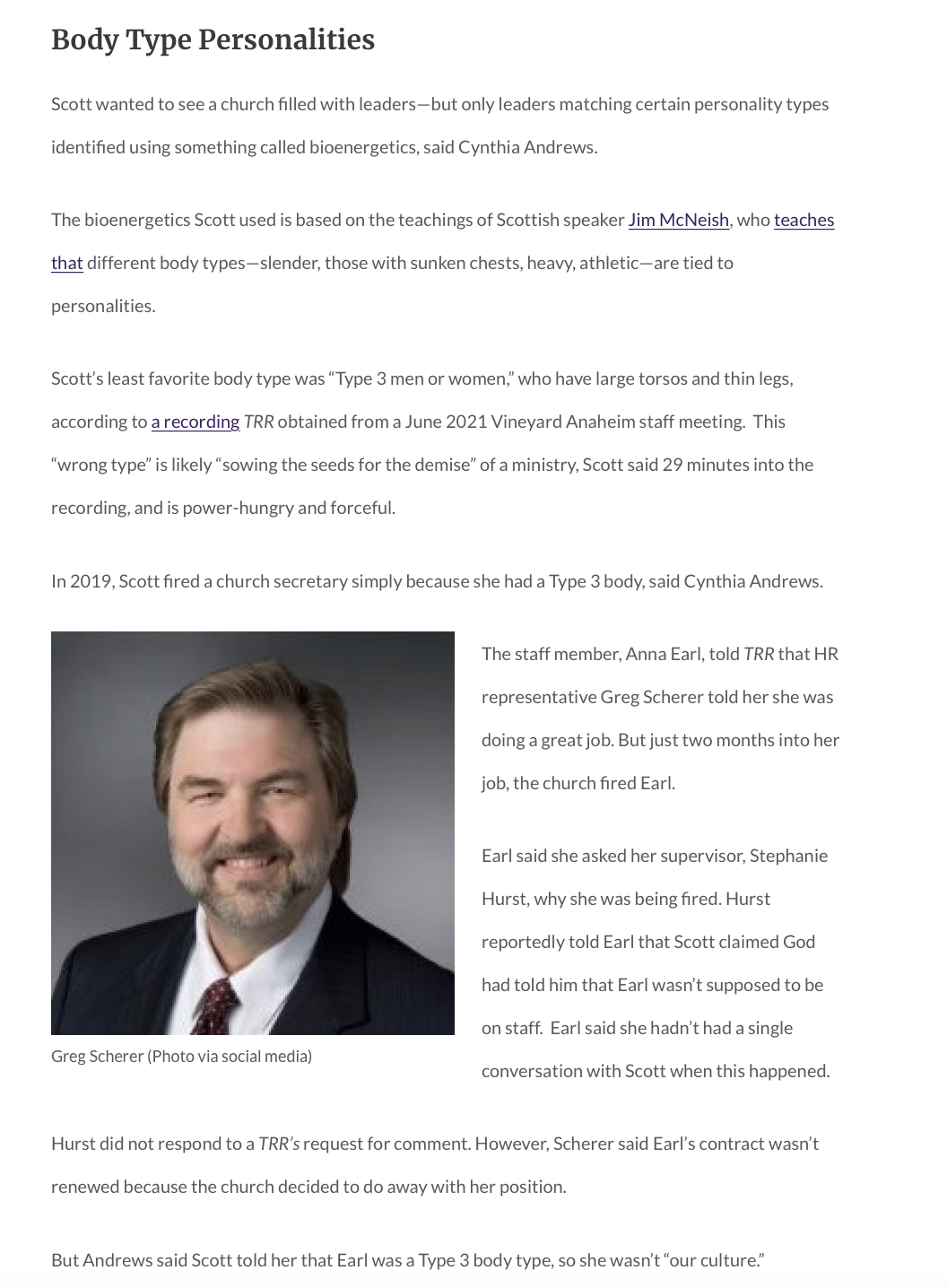
Recently McNeish has hit the Christian Press as a key influence behind an alleged bullying practice at the (mini)megachurch Causeway Coast Vineyward. According to the Roys Report Senior Pastor Alan Scott used McNeish’s Bioenergetics teaching (a Jungian based idea that body types equate to personalities) to hire and fire.
Back on the leadership programme McNeish described Justin Welby (to people handpicked to hang on to the Archbishop’s coattails) as a ‘Yellow Leader’. The Yellow Leader is basically someone who has elevated beyond old certainties and even old questions, rising above conservatives and enlightened revisionsists alike. From the Yellow viewpoint on the spiral you can survey all you see and have a perspective lesser mortals can’t cope with. But crucially you are not stuck in a superior ivory tower on the hill. As a Yellow Leader you can take the ‘be all things to all men’ and put it on steroids. You can go up and down the spiral at will and whether you are talking to a ‘blue’, ‘green’ or ‘purple’ meme person you can sound like you agree with them on everything. You speak their truth, their way and (because you have climbed the mountain and have a higher viewpoint) you call or nudge them upwards a little where you can.
You go to Africa and say one thing.
You go to parliament and say another thing.
You meet activists from various pressure groups in back to back meetings and spin on a circle.
You rise above it all, until a social media age questions how the guy we met in Ghana can have given that speech at Synod.
Spiral Dynamics is ultimately a gnostic dream. A dream that there is a level of enlightenment and superiority I can attain to that takes me beyond the simple, divisive truth of the man who said: ‘unless you eat my flesh.’ Like all gnostic dreams it is based on unreality and when it starts to tumble down it is terrible. I spent a year trying to persuade my supervisors at Durham University to take Spiral Dynamics seriously, so I could use it as a conversation partner in my thesis. Maybe it could explain how we evolved as a network I thought, maybe we are leaving behind childish things, maybe this is what ‘changing the model not the message’ means, finding ways to talk to later-modern people while offering ‘cake or cake’. But the more I looked into it the more disturbing its roots got, and flimsier the evidence for it was. They begged me to take it out for my own good. Not even academically credible as a conversation partner. A distraction from the main thing. Interesting for podcast afficiendos and leadership seminars but not a rock to build your life on.
Within the Church of England this sort of thinking has produced an Orewellian nightmare of the most grotesque proportions. Bishops stand up and say black is white and white is black and expect us to swallow the poison. Bishops see themseles as a ‘centre of unity’ who can speak to all levels of the spiral, but get a headache when you put all the levels in the same room because they have to talk in three or four directions at once. Bishops who have forgotten that their job is defend the faith once given, not to reach a ‘higher level of consciousness’ that would give the Buddha altitude sickness.
Within the charismatic church I imagine it has had an effect too. We’re well known for chasing after dreams, and visions. Paul had to tell his most charismatic church to keep their feet on the ground. It plays into our sense of superiority over conservative colleagues. We’ve got an extra level of revelation than you. A second blessing. A foot on a ladder even if that may be up the wrong wall. A way of relating to others in the wider church while we climb up to our own promotion position. But the wall came tumbling down on Babel’s tower, and will on this too. (Incidentally and somewhat ironically if you wanted to put Wimber on the Spiral he would be a ‘level of consciousness’ below the conservatives, as he embraced a pre-modern miracle working spirituality such as had characterised the celtic saints).
Preaching the Positives
More briefly I want to mention some of the ways in which our responsiveness to perceived culture today can change our message. This is written up in far more detail in my thesis, links available at the end.
The essence is this: If we communicate that Christianity is a ‘live worth living’ (our 1990s charismatic mantra), and locate that ‘worth living’ in the here and now, and if we apply our teaching to give people tangible benefits right now, then eventually our focus will narrow to the point that we have left out big bits of our message so regularly and so often that they don’t remain big bits of our message anymore.
Instead of giving a framework that produces a ‘holy people for a holy God’, instead of making an army (to use John Wimber’s phrase), we make a audience who drink the soothing coolaid we supply. Feeling low? God want to raise you up. Feeling blue? God wants to comfort you. Feeling lonely? God wants to place you in a family. It’s mass therapy, without doing what a therapist really should do… looking at where you have come from and where you are going. Somehow those two end points of faith have got lost. Our original sin and our eternal destiny(ies) are missing from the story, as are the consequences of living like a rescued redeemed people in amazement and gratitude at our salvation, and living as those who know a Day is coming where judgment will fall.
More so, we have also produced preachers who are caged birds. The image comes from China. There authorised churches have certain books and themes they cannot preach from because government officials are looking on and censor them under threat of death or imprisonment. So their ‘free’ counterparts in the underground church call them caged birds.
Here our charismatic church is so domesticated you can leave the cage door open. We fly in all by ourselves and stay to ‘preach the positives’ in the hope that this will remove barriers of entry to others. The nightingale cry luring others into the cage too. You can read more in my thesis, but as we began to see in the last chapter the impact on generations is staggering. If you don’t teach the whole counsel of God, but just a truncated ‘me-orientated’ scheme, the next generation only have a ‘me-orientated’ religion to chew on – or swallow like babies milk.
Dear friends, some of our best communicators have preached the positives and got many into the gateway of the Kingdom of Heaven. God has used our networks greatly. But as we now see things spiraling out of control above us now is the time to ask the questions… were we climbing up the right hill anyway? Is theology being used all around us to hide atheism/agnositcism or even something sinister? Why did Jesus choose death over cake (bread) in Matthew 4 and beyond…?
Is it time to rise up and lead people from the gateway into the whole counsel of God. To burst out of the cages and preach the truth unencumbered by a need for popularity or the winsomeness of the world. Is it time to say you can keep the world (and the world’s grip on the church) but give me Jesus?
————————————————
Next week: Look deep: What would the saints say today?
Previous Posts in this series: Foreword | introduction | Remember The Baby | The Bathwater Needs Flushing | Driven to Distraction by Success | Whoever Pays the Piper | Losing My Religion
HTB Network Thesis in 30 Parts: Featuring: Origins | Renewal | Success Culture | Managerialism | Theology | Trajectories.
 Your name is like honey
Hi Richard
I recently came upon this blog and series. You are the first person I have come across to actually write down some of the concerns I’ve had about the UK Charismatic church, concerns I’ve had for sometime
Fascinating reading! Would love to discuss this with you if we ever meet (we’ve never been introduced, though I was playing the organ at the wedding anniversary service in Cambridge of some mutual friends of ours just over a year ago!)
Jon
LikeLike
thanks Jon, kind of you to be in touch
Would be great to talk
LikeLike